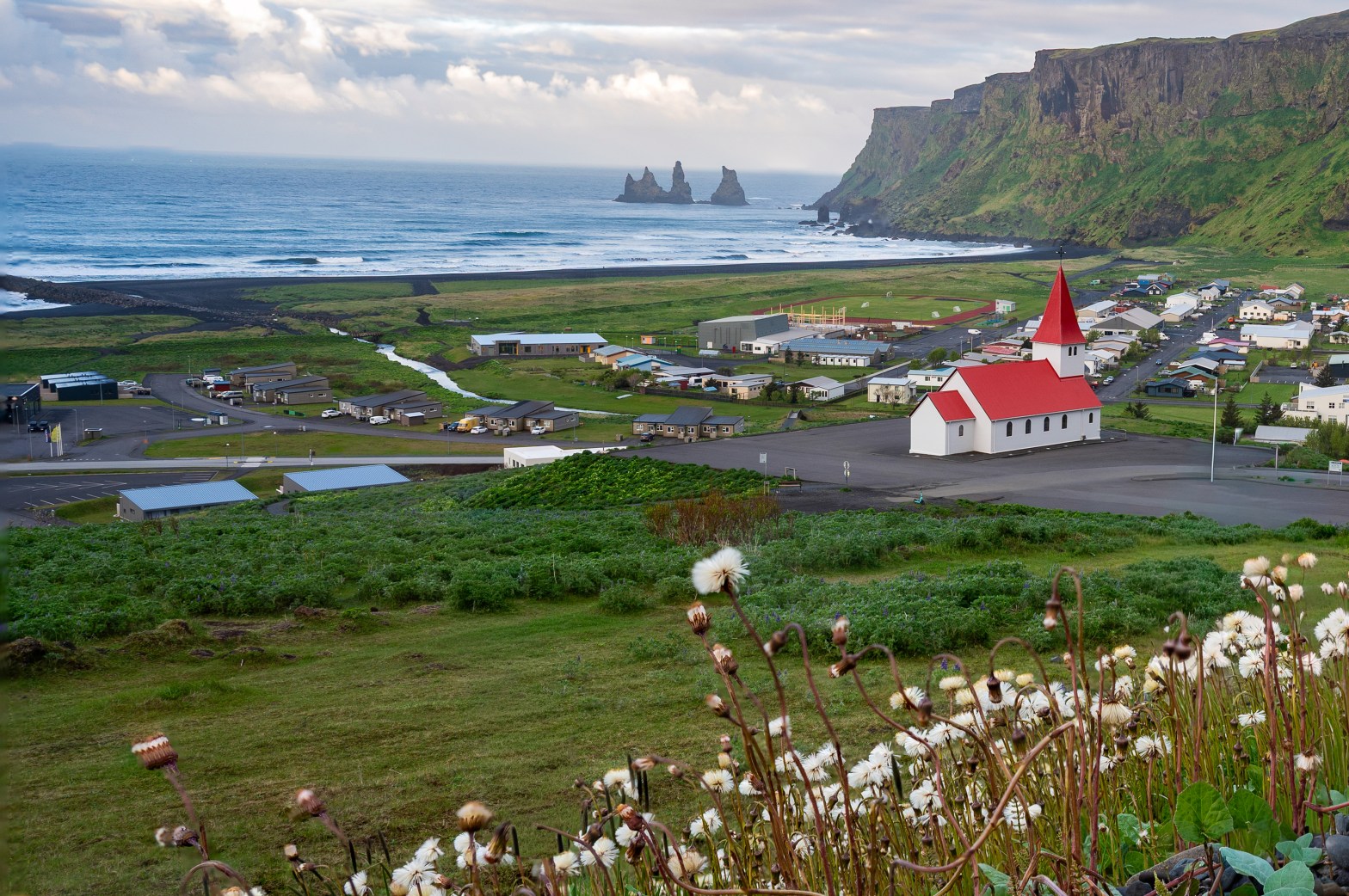
Driving Counterclockwise Around the Land of Fire, Ice and Endless Drama
Why the Ring Road?
The Ring Road is Iceland’s main circular road, officially known as Route 1. As the name suggests, it goes almost all around the country and gives you a wonderful glimpse of Iceland’s many different faces.
And Iceland has many faces.
One day you are driving beside green farmlands and waterfalls. The next day, you are standing in front of glaciers and floating icebergs. A little later, the landscape changes again into black beaches, lava fields, fjords, snow-covered mountains, geothermal areas and quiet fishing villages.
For a first-time visit to Iceland, especially if you love road trips, the Ring Road gives you the most complete experience.
Since we had 8 nights in Iceland, we planned our route in a way that allowed us to complete the Ring Road without making the trip feel like a race. It was not exactly a slow, leisurely holiday where you spend two nights at every place, but it was still very manageable and comfortable.
We chose to drive counterclockwise from Reykjavík.
There was a simple reason for this.
The southern part of Iceland has some of the most famous sights — waterfalls, black sand beaches, glaciers, Jökulsárlón Glacier Lagoon and Diamond Beach. We wanted to experience these highlights early in the trip when everyone was fresh and excited.
The last long stretch of our Ring Road journey fell towards the end. That day was mainly a driving day, without too many major sightseeing stops. By keeping this stretch later, we could complete the more dramatic and attraction-heavy parts of Iceland earlier and use the final leg to simply enjoy the drive back towards Reykjavík.
In hindsight, this worked very well for us.
The counterclockwise route gave the trip a lovely flow: famous South Coast sights first, quieter East Fjords next, the raw landscapes of North Iceland after that, and finally the long return towards Reykjavík.
It felt like Iceland slowly changed its costume every day.
And honestly, that is the real charm of driving the Ring Road.
Day 1: Keflavík to Golden Circle
Airport Hotel, Þingvellir, Brúarfoss, Gullfoss and Geysir
Day 1 felt like the opening scene of a grand movie — not too loud, not too dramatic, but enough to tell you that something special had begun.
Our Iceland journey technically began in the middle of the night.
Our flight landed late at Keflavík Airport, so we had wisely decided not to start driving immediately. After a long international journey, tired eyes, a new country, unfamiliar roads and left-hand drive are not exactly the best combination.
So our first stop was not a waterfall, glacier or volcano.
It was a hotel bed.
We stayed at Aurora Hotel, located right at Keflavík Airport. This turned out to be a very convenient decision. The hotel is just a short walk from the terminal, and our rental car company, Blue Car Rental, was also located nearby.
No late-night transfers.
No unnecessary taxi rides.
No hunting for car rental counters after midnight.
Sometimes, good travel planning is not about doing something heroic. It is about making sure the first night is boringly comfortable.
And this was one of those decisions we were very happy about.
We had also decided to keep Reykjavík for the last part of the trip. After landing, we wanted to move directly towards nature rather than spend time in the city. Also, driving through Reykjavík felt like something we would be more comfortable doing towards the end, once we had become used to Icelandic roads, driving rules and the car itself.
By the last day, we would have enough Iceland driving experience under our belt.
Or at least enough confidence to pretend we did.
First Morning in Iceland
After a good night’s rest, we woke up to our first Icelandic morning.
Since we travelled in the last week of May, the daylight was almost endless. There was barely a couple of hours of sunset-like darkness. During our entire trip, we never really saw Iceland in proper darkness.
For travellers from India, this feels quite unusual initially. Your watch tells you it is late evening, but the sky behaves as if it is still afternoon. It takes a day or two for the mind and body to understand what is going on.
Before starting the actual Ring Road journey, our first practical stop was a Krónan supermarket.
This is something I would strongly recommend, especially for Indian families doing a self-drive trip. We stocked up on ready-to-eat meals, snacks for the road, fruits, drinks and a few basic food items. Once you leave the bigger towns, food options become fewer, timings become limited, and eating out for every meal can become quite expensive.
So before chasing waterfalls, we did the sensible Indian thing.
We stocked the car.
Þingvellir National Park
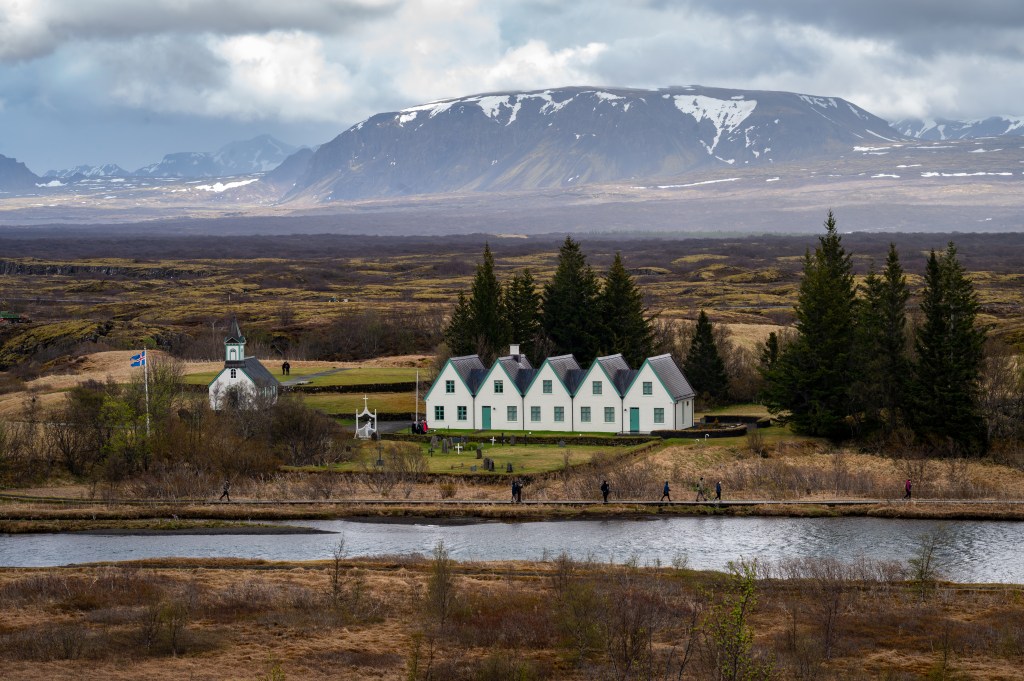
Our first sightseeing route was the famous Golden Circle, and our first major stop was Þingvellir National Park.
Þingvellir is one of the most historically and geographically important places in Iceland. It is the site of Iceland’s ancient parliament and is also famous for its unique location between the North American and Eurasian tectonic plates.
We parked at P1, which gives easy access to the main walking area.
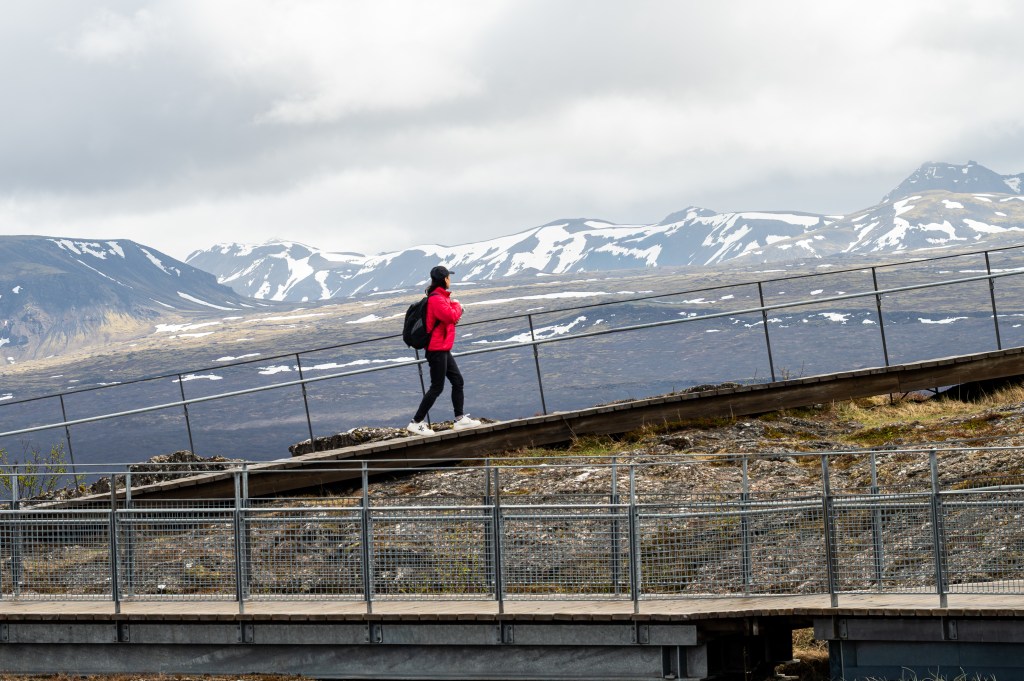
Walking through the gorge at Þingvellir is a different experience. On both sides, you can see dramatic rock walls formed by the shifting of tectonic plates. There is something quite special about walking through a place where the earth itself is slowly pulling apart.
It is not just another viewpoint.
It feels like walking through geography, history and geology at the same time.
Because of time constraints, we spent only a couple of hours here. For our itinerary, that felt enough. Of course, if you love slow walks, history or photography, you can easily spend more time. But for a Ring Road trip where the day has multiple stops, a couple of hours at Þingvellir works well.
Brúarfoss — The Blue Waterfall
Our next stop was Brúarfoss, also known as Iceland’s blue waterfall.
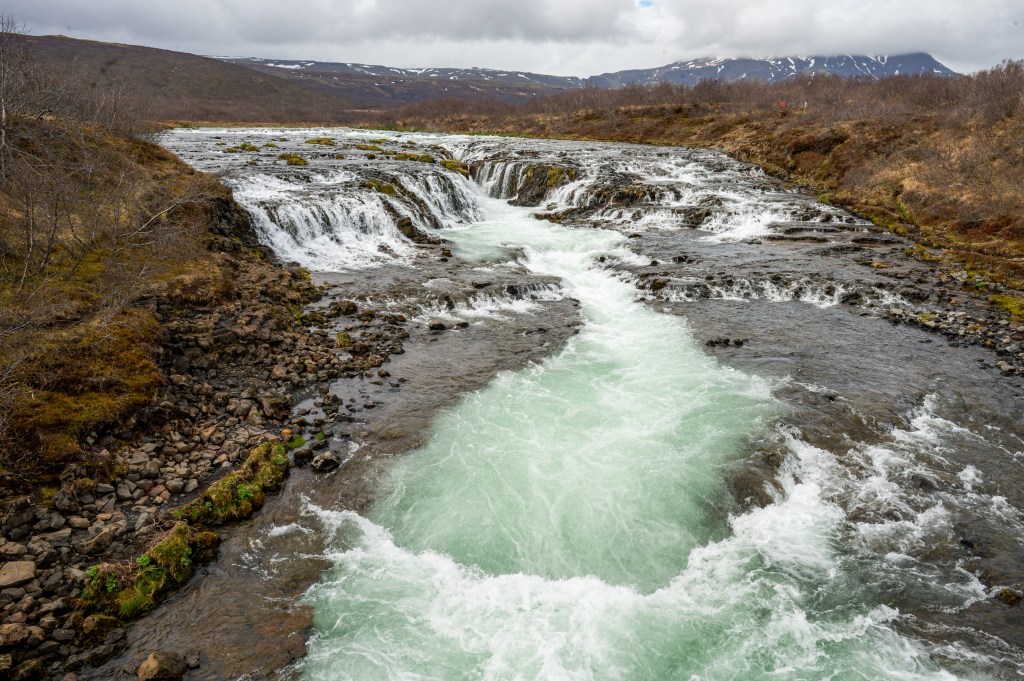
And blue it truly is.
The colour of the water is striking. The glacial meltwater, narrow channels and mineral-rich landscape together give the waterfall its beautiful blue tone. It is not the largest waterfall in Iceland, and it is not as dramatic as Gullfoss or Skógafoss, but it has a charm of its own.
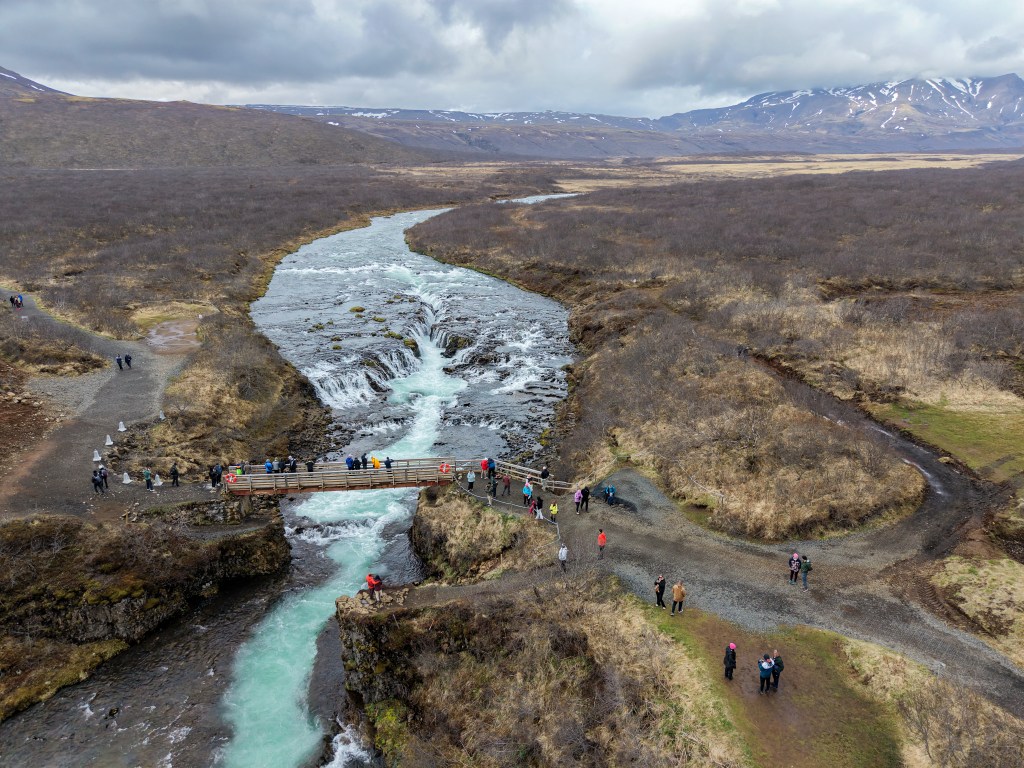
It was definitely worth the stop.
Gullfoss — The Magnificent Waterfall
From Brúarfoss, we moved on to the mighty Gullfoss.
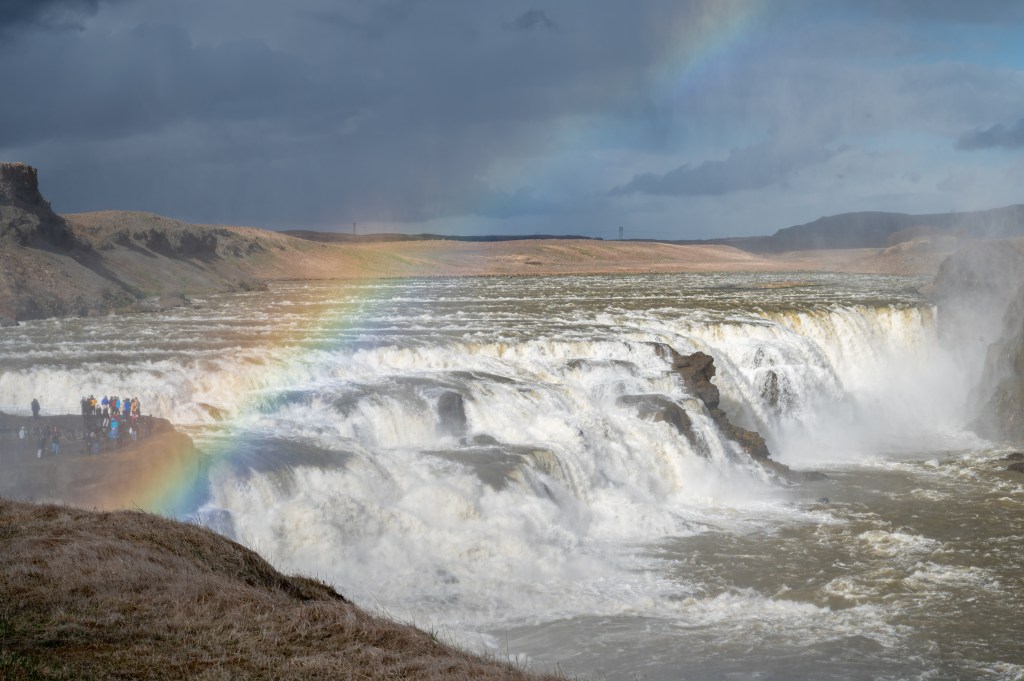
And this is where Iceland starts showing its power.
Gullfoss is one of the most famous waterfalls in Iceland, and for good reason. The sheer volume of water, the wide landscape, the sound, the spray and the multiple viewing angles make it a truly magnificent sight.
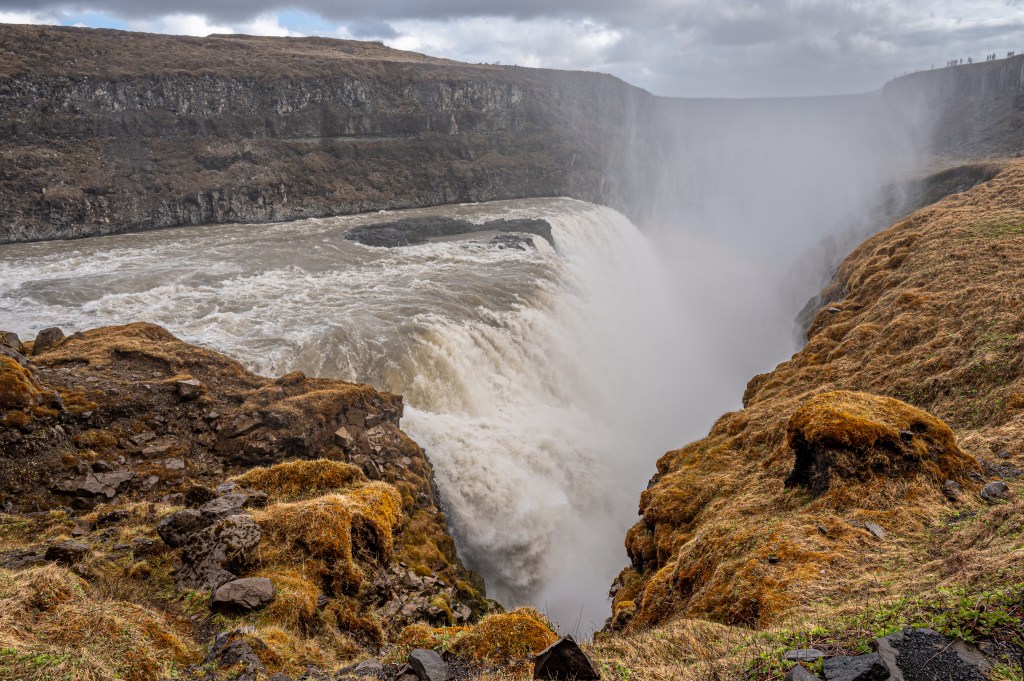
This is not a place to rush.Give yourself ample time here.
There are different viewpoints from where you can admire the waterfall. Each gives a slightly different perspective. From some points, you see the vastness of the river. From others, you feel the force with which the water drops into the canyon.
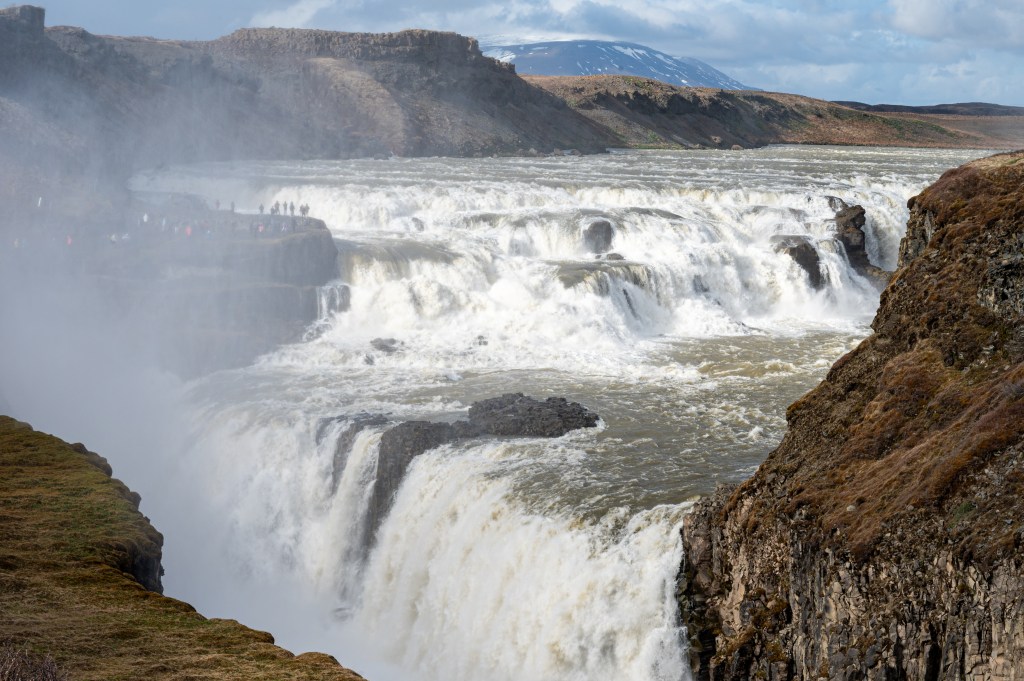
And if the weather is kind, do not miss the rainbows.
For us, Gullfoss was one of the first moments where we truly felt: yes, this is Iceland.
Big. Raw. Dramatic.
Stay at Litli Geysir
Our hotel for the night was Litli Geysir, located right opposite the Geysir geothermal area.
This location turned out to be excellent.
Most visitors see Geysir as part of a Golden Circle day trip and arrive during busier hours. But because we stayed right across the road, we could explore the area early the next morning, almost without crowds.
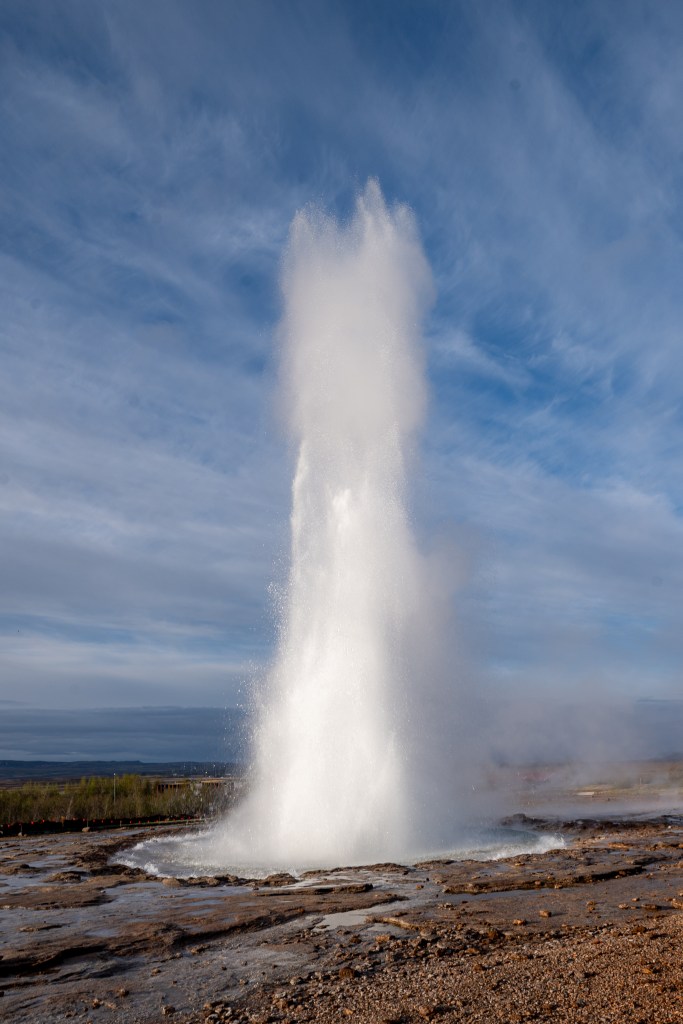
The Geysir area is famous for its geothermal activity, especially Strokkur, which erupts every few minutes. Watching hot water suddenly burst out of the earth is always exciting, no matter how many times you see it.
There is also a trail leading to a viewpoint above the geothermal area. If you have time and energy, this short climb is highly recommended. From the top, you get sweeping views of the steaming ground, distant mountains and open Icelandic landscape.
It is a wonderful place to understand how alive Iceland’s earth really is.
Dinner at Friðheimar / Vínstofa
For dinner, we had planned to visit the famous tomato farm restaurant, Friðheimar.
Friðheimar is very popular, and advance booking is strongly recommended. Unfortunately, we did not get a reservation at the main restaurant. However, we managed to get a table at their sister restaurant, Vínstofa.
And it turned out to be a lovely experience.
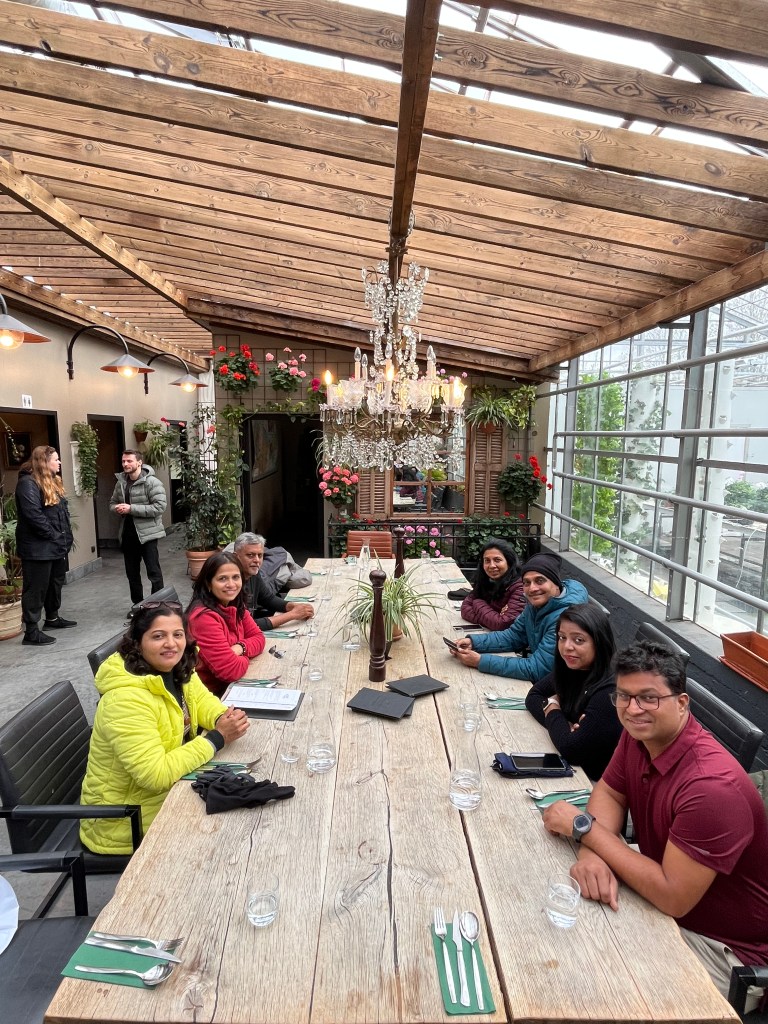
The tomato soup was absolutely worth the visit. Warm, fresh and comforting, it was perfect after a day of driving and sightseeing. For Indian travellers, especially vegetarians, this is a very good food stop to consider on the Golden Circle route.
After a long first day in Iceland, a bowl of hot tomato soup felt almost like travel medicine.
Day 1 Summary
Route: Keflavík Airport → Þingvellir → Brúarfoss → Gullfoss → Geysir
Approximate drive time: 3 to 3.5 hours, excluding stops
Hotel stay: Litli Geysir
Previous night stay: Aurora Hotel, Keflavík Airport
Highlights: Þingvellir National Park, Brúarfoss, Gullfoss, Geysir area, Friðheimar/Vínstofa dinner
Our first day was not too hectic, but it was packed with variety — history, geology, waterfalls, good food, easy driving and enough wow moments to make us excited for the rest of the Ring Road.
And the best part?
This was only Day 1.
Day 2: Golden Circle to Vík
Geysir, Seljalandsfoss, Gljúfrabúi, Skógafoss, Dyrhólaey and Reynisfjara
Iceland often behaves like a beautiful model changing designer clothes every few hours — green farmlands, waterfalls, black sand, sea cliffs, wild winds and dramatic skies.
Our route took us from the Golden Circle to the beautiful village of Vík, with some of South Iceland’s most famous sights on the way — Seljalandsfoss, Gljúfrabúi, Skógafoss, Dyrhólaey viewpoint and Reynisfjara black sand beach.
This was the day when Iceland stopped being scenic and became cinematic.
Morning Around Geysir
Since we were staying at Litli Geysir, right opposite the Geysir geothermal area, we had the advantage of exploring it early in the morning.
The area was quiet, the crowds had not yet arrived, and we could enjoy the geothermal landscape at a relaxed pace. There is something childlike about standing in front of Strokkur, waiting for it to erupt.
You know it is going to happen.
You know it erupts every few minutes.
And still, every time the water suddenly shoots up into the air, everyone reacts with the same surprise and excitement.
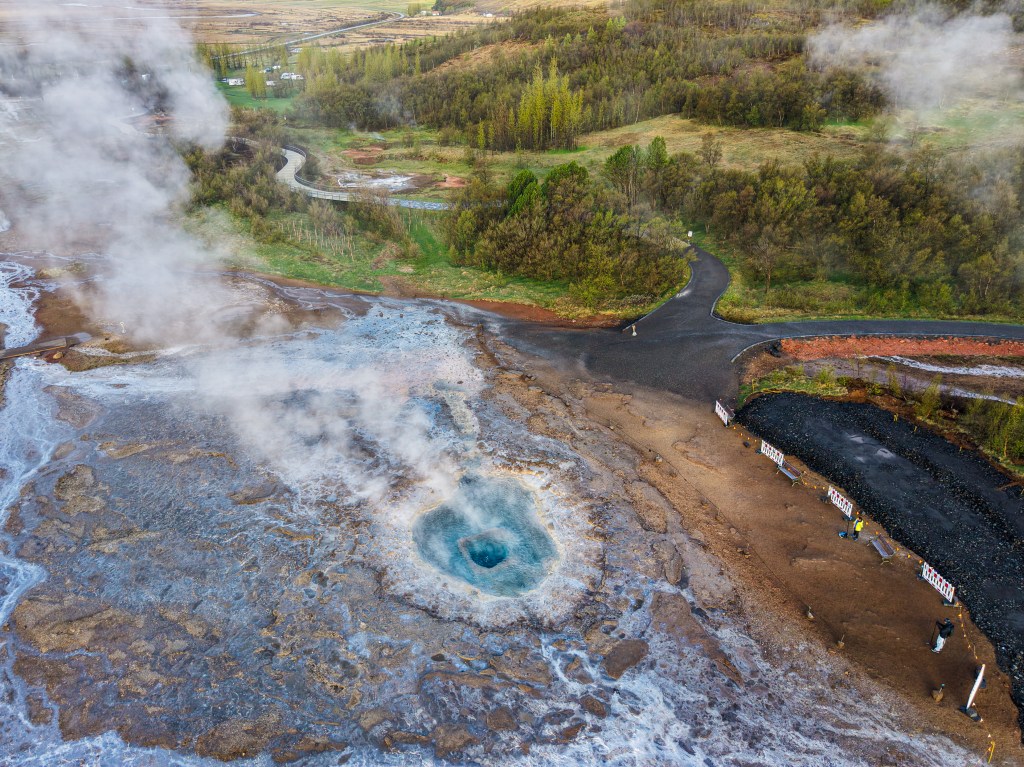
It is one of nature’s simplest magic tricks, and it works every single time.
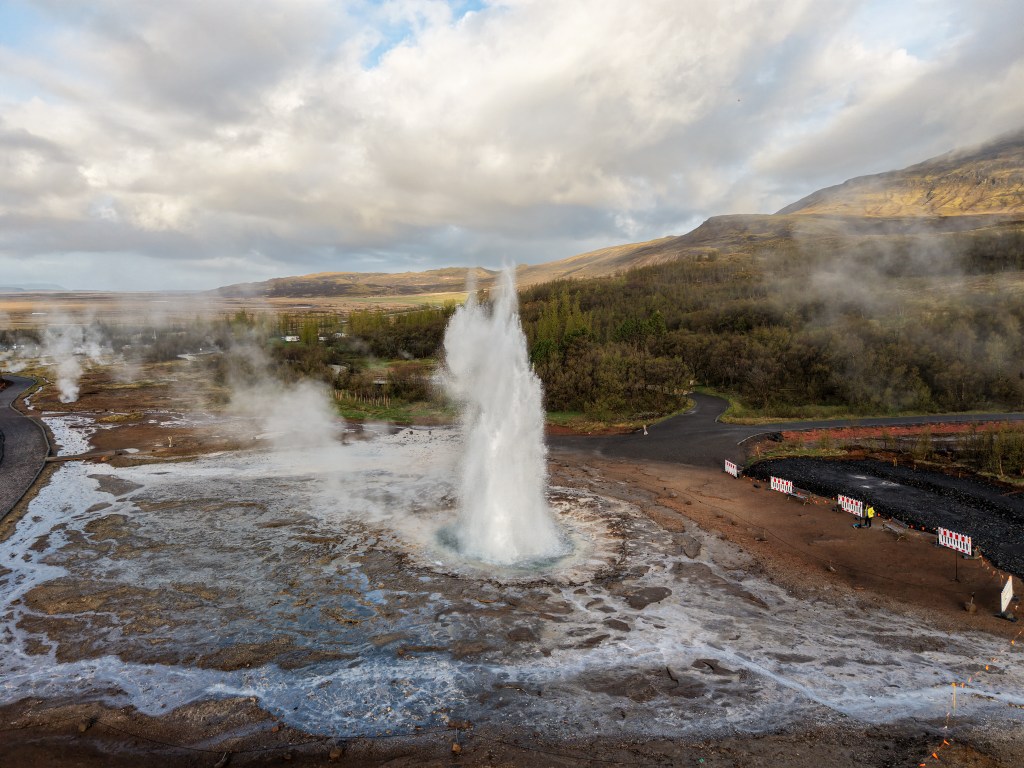
We also walked up the small trail behind it. The viewpoint from above gives beautiful sweeping views of the entire region — steaming earth, distant mountains and the wide-open Icelandic landscape.
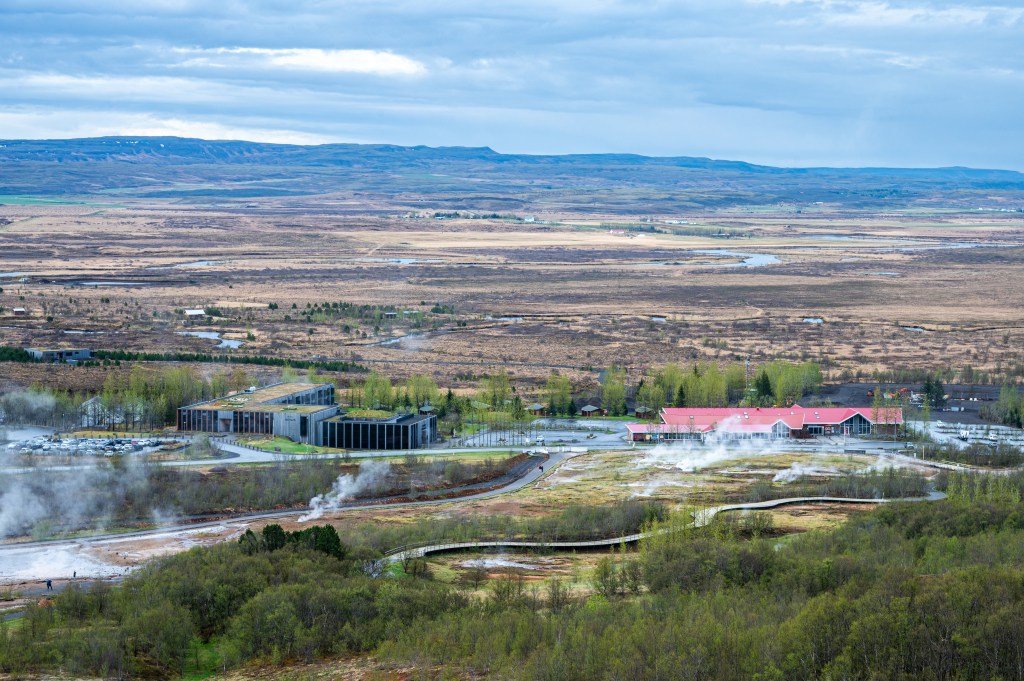
After this, we had breakfast at Hotel Geysir, adjacent to Litli Geysir. Frankly, it had one of the loveliest hotel interiors we saw on the trip. The ambience was warm, elegant and beautifully designed — a perfect start before a long day on the road.
A Day for Rain Gear
Day 2 is the day when your rain gear earns its place in your suitcase.
This is not the day to keep your waterproof pants and jackets neatly folded in the car. You are going to get wet. And that is exactly how it should be.
The waterfalls on this route are not meant to be admired only from a safe, dry distance. You feel them better when the mist hits your face and your camera lens starts protesting.
Seljalandsfoss — Walking Behind the Waterfall
Our first major waterfall stop was Seljalandsfoss.
This is one of Iceland’s most famous waterfalls, mainly because you can actually walk behind it. The waterfall drops from a tall cliff, and a path takes you around the back, allowing you to see the falling water from behind the curtain.
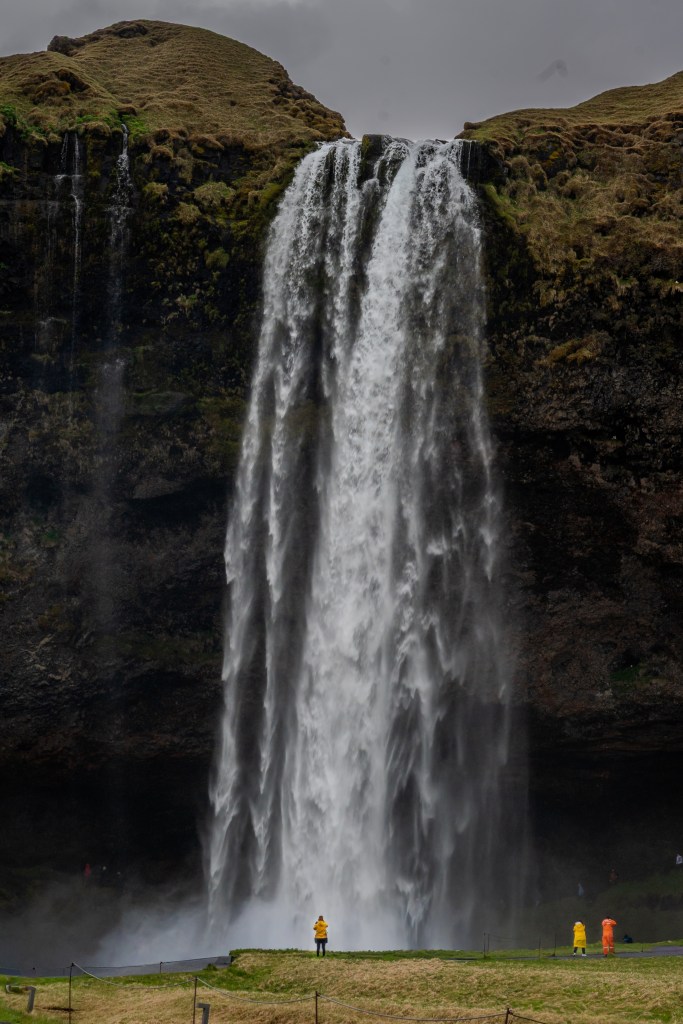
It is a beautiful and slightly surreal experience.
From the front, Seljalandsfoss looks elegant. But once you walk behind it, the experience becomes more dramatic. The sound of the water, the spray, the slippery path, the open landscape visible through the falling stream — everything comes together beautifully.
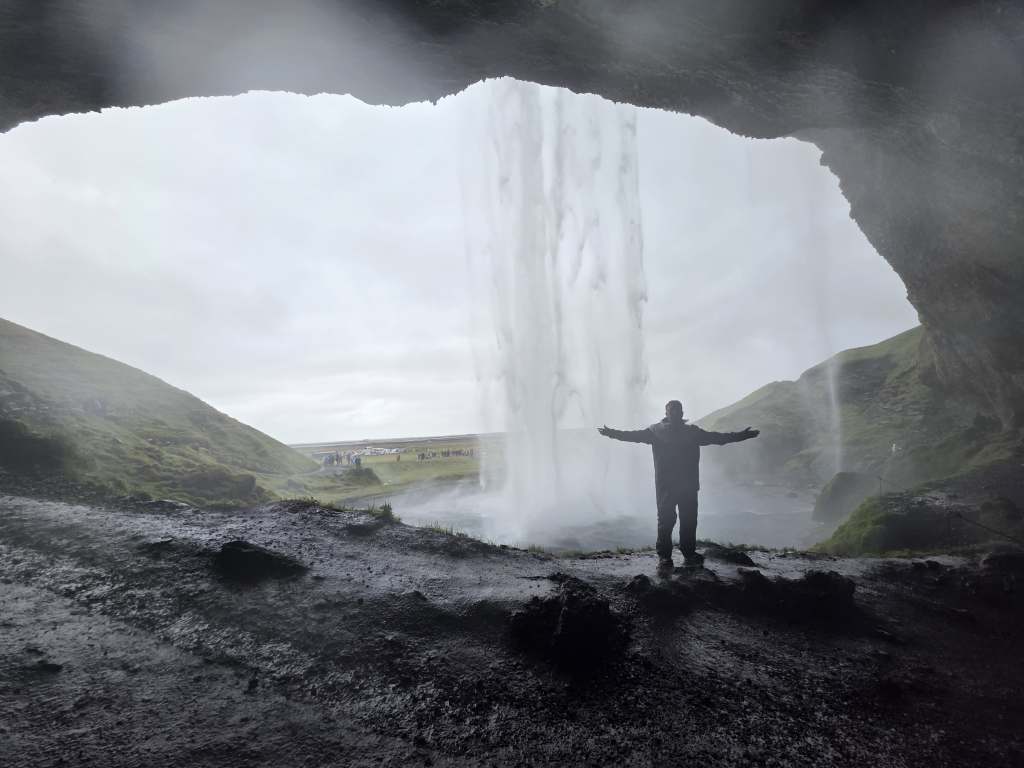
You will almost certainly get wet here, but that is part of the fun.
Some memories need a little soaking.
Gljúfrabúi — The Hidden Waterfall
Just about half a kilometre from Seljalandsfoss is another beautiful waterfall called Gljúfrabúi.
Many travellers miss it, but they really should not.
Gljúfrabúi feels completely different from Seljalandsfoss. It is partly hidden inside a narrow canyon, and to reach it properly, you have to enter through a gap in the rocks. The waterfall then appears suddenly, falling inside a small enclosed space.
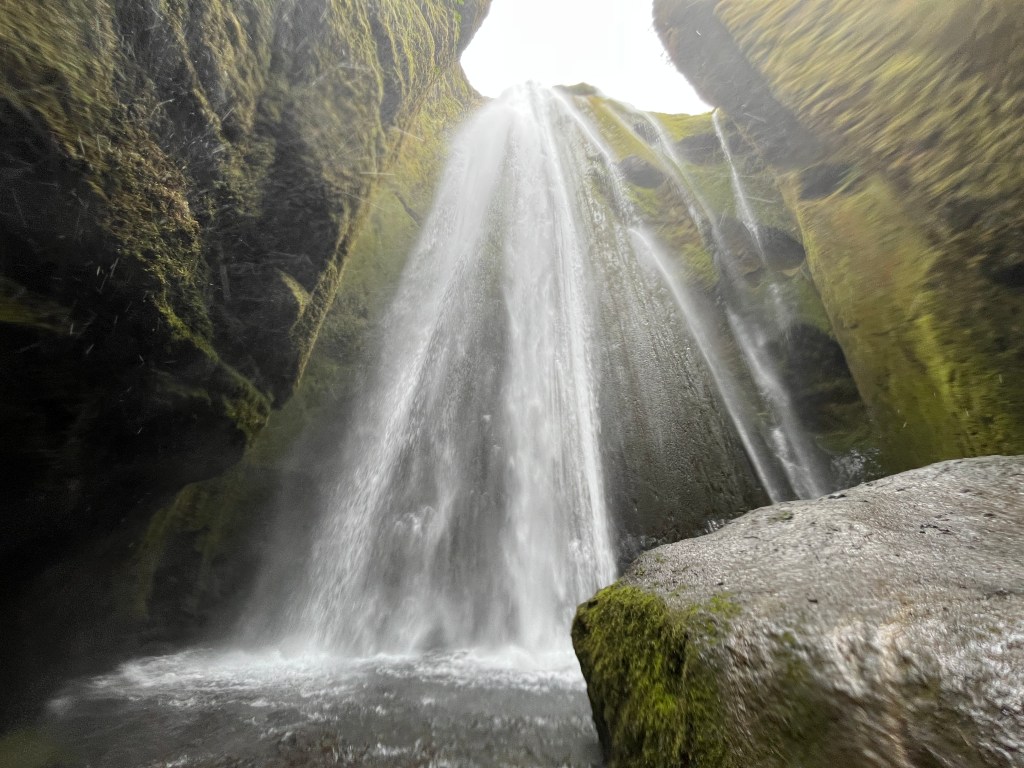
It feels secretive and dramatic.
Compared to the open and graceful Seljalandsfoss, Gljúfrabúi feels like a hidden chamber of nature. The spray is strong, the rocks are wet, and the whole place has a raw, adventurous feel.
If you are already stopping at Seljalandsfoss, do not skip Gljúfrabúi.
Skógafoss — Power and Panorama
After getting thoroughly soaked, we continued towards the next mighty waterfall — Skógafoss.
Skógafoss is wide, powerful and beautifully framed by cliffs. Standing near the base, you can truly feel its force.
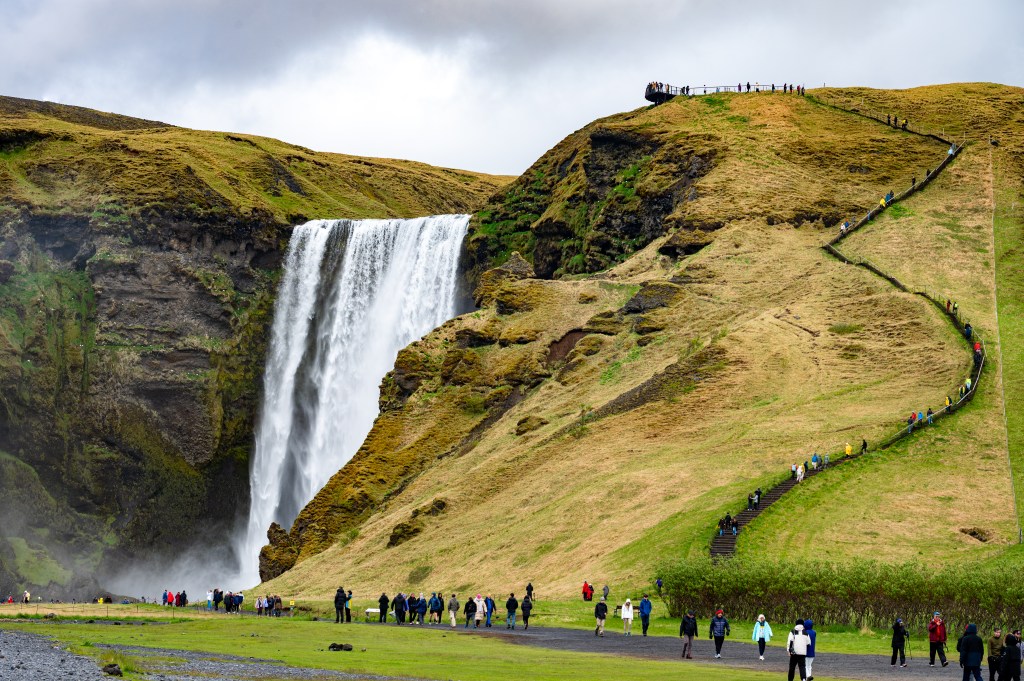
And yes, you should go close enough to get wet.
After taking photographs from below, we climbed the staircase beside the waterfall. The stairs take you to the top, from where you get a completely different perspective. You can see the waterfall dropping down from the edge, the river flowing towards it and the vast landscape opening up around you.
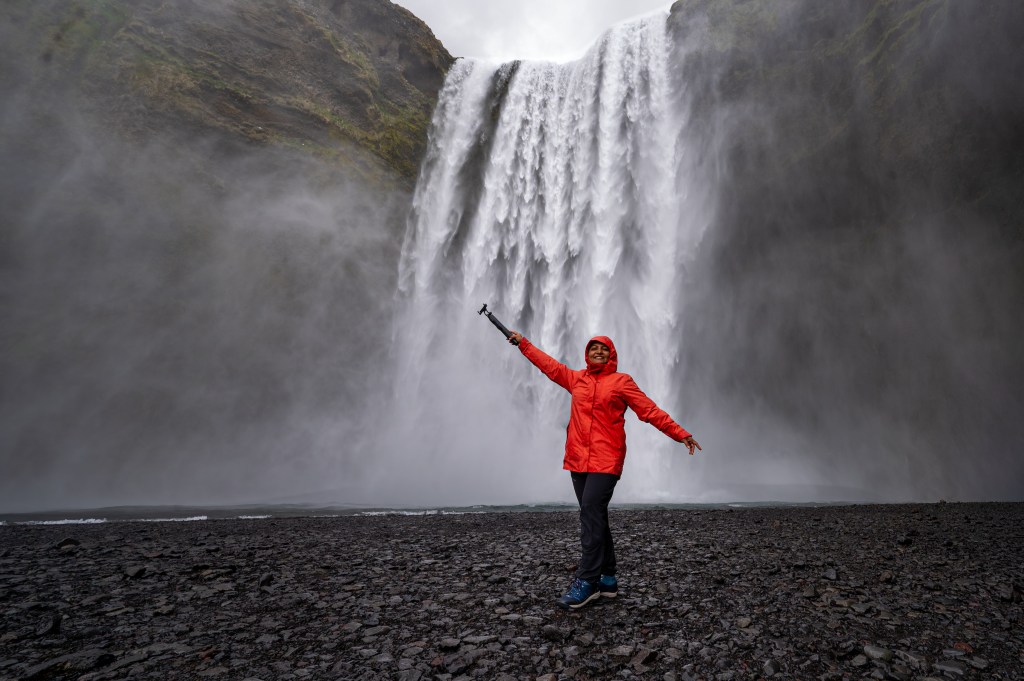
The view from the top is worth the climb.
Further uphill, there is a hiking trail that continues along the river and eventually leads towards the glacier area. It looked extremely tempting. But once again, the clock was ticking and, like a strict schoolteacher, it denied us permission.
Near Skógafoss, there is also a fish and chips stall which is definitely worth a stop. After waterfalls, wind and walking, hot fish and chips feel like a small reward from the travel gods.
Dyrhólaey — Wind, Cliffs and Pure Magic
Our next stop was Dyrhólaey viewpoint.
And this place fully justified every warning about Icelandic wind.
The wind was unbelievable.
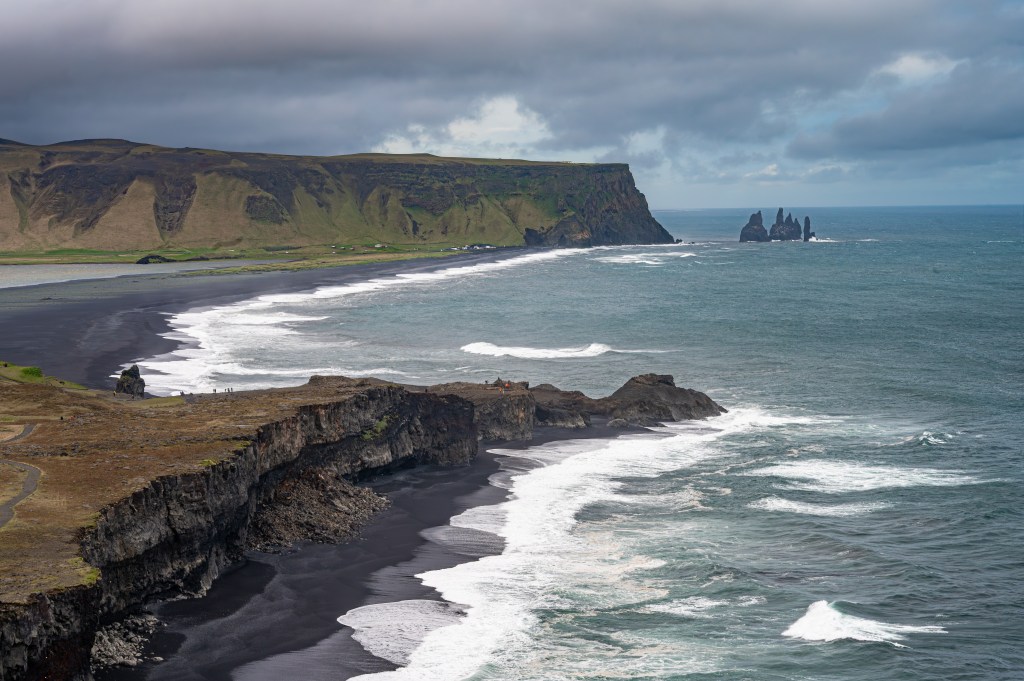
At times, we could hardly stand straight. It was the kind of wind that makes you laugh, struggle, bend, hold your jacket tightly and wonder whether your next photograph will be of the landscape or of you flying towards the Atlantic.
But strangely, it was enjoyable.
It immediately reminded me of the final fight scene from Jackie Chan’s Armour of God, where the wind becomes almost a character by itself. Dyrhólaey felt similar — wild, dramatic and slightly theatrical.
The view from the lighthouse area is simply unreal.
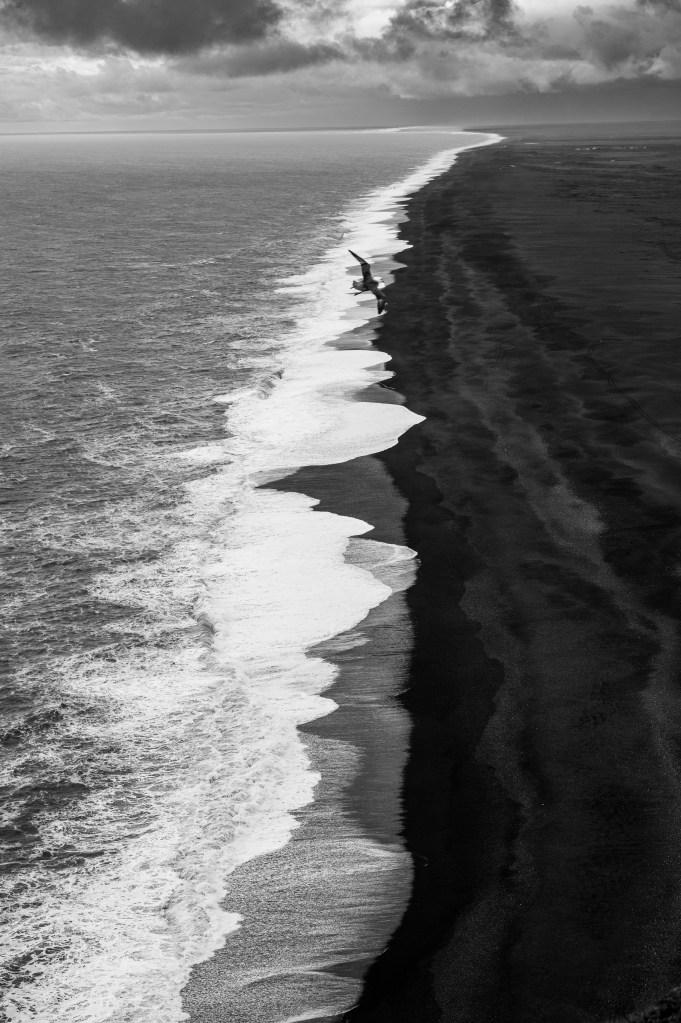
On one side, there is a vast stretch of black sand running into infinity. On the other side, there are sea cliffs, rock formations, ocean waves and the colourful lighthouse standing bravely against the wind.
This was pure magic.
Not gentle magic.
Icelandic magic — the kind that arrives with 70 km/hour wind and tries to remove your cap.
Reynisfjara Black Sand Beach
From Dyrhólaey, we continued to Reynisfjara black sand beach.
The black volcanic sand, roaring Atlantic waves and hexagonal basalt columns make this place a spectacle. The basalt columns look almost architectural, as if nature decided to try its hand at design and did a better job than most of us.
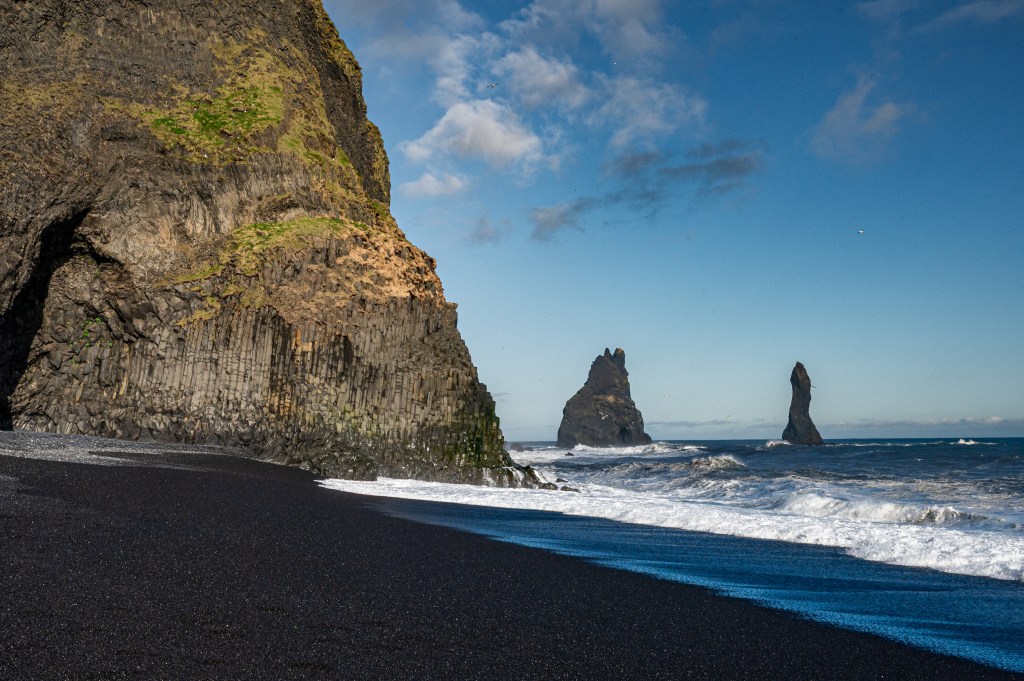
But Reynisfjara is also a place where you must be very careful.
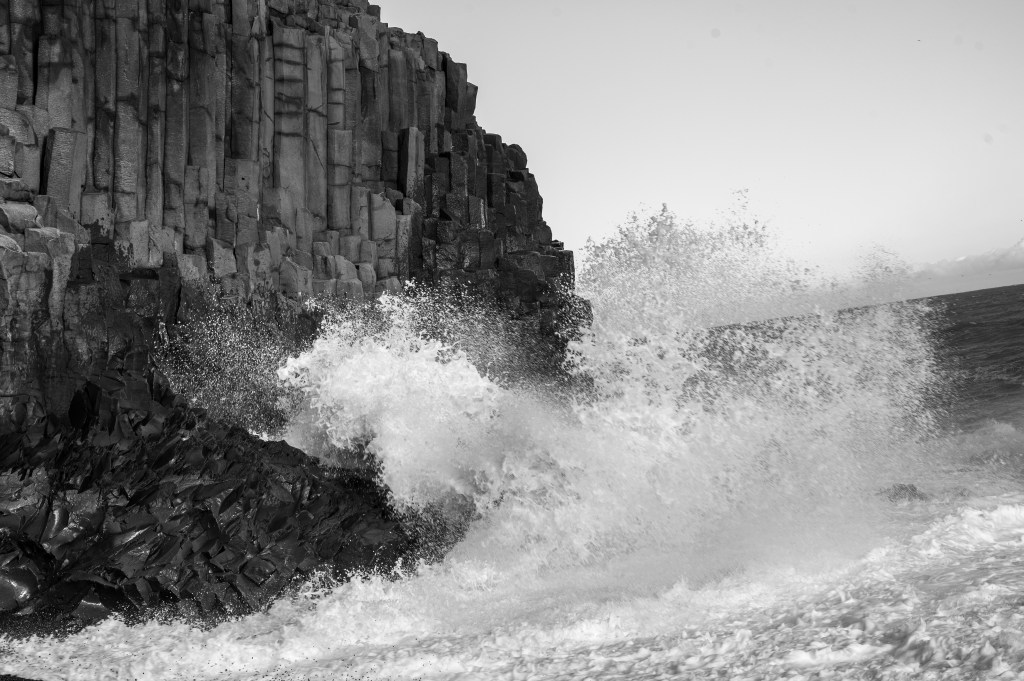
The waves here are dangerous and unpredictable. Sneaker waves can suddenly rush much farther up the beach than expected. This is not the place to turn your back to the ocean or go too close to the waterline for a photograph.
Admire the waves, photograph them, enjoy the drama — but respect the sea.
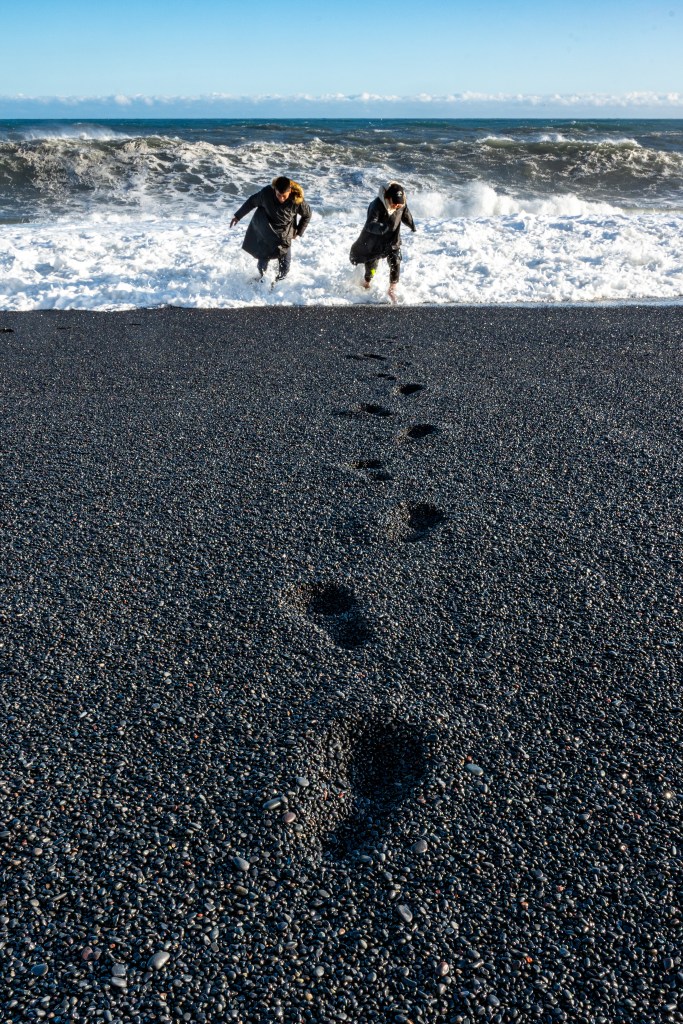
At Reynisfjara, beauty and danger stand very close to each other.
Evening and Morning in Vík
Our stay for the night was in Vík, a small and beautiful village that felt like a destination in itself.
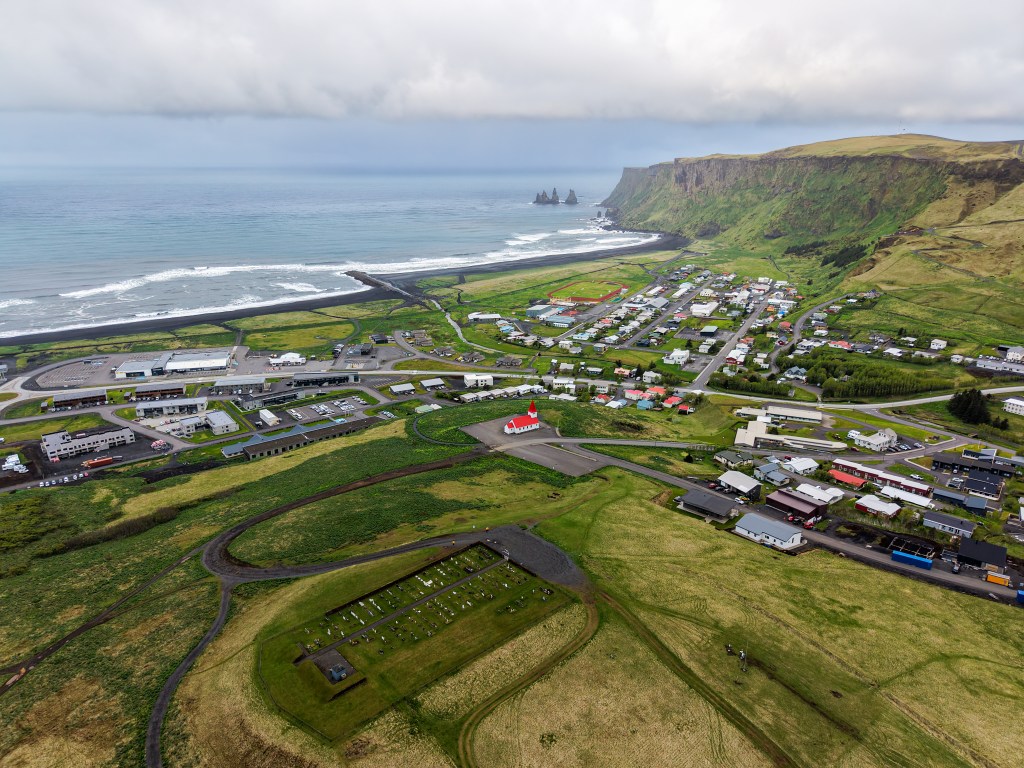
After a long, cold and windy day, we went to The Soup Company for dinner. In that chilly weather, a hot bowl of soup was exactly what we needed.
Sometimes, after a full day in Iceland, you do not need a fancy dinner.
You need soup, warmth and sleep.
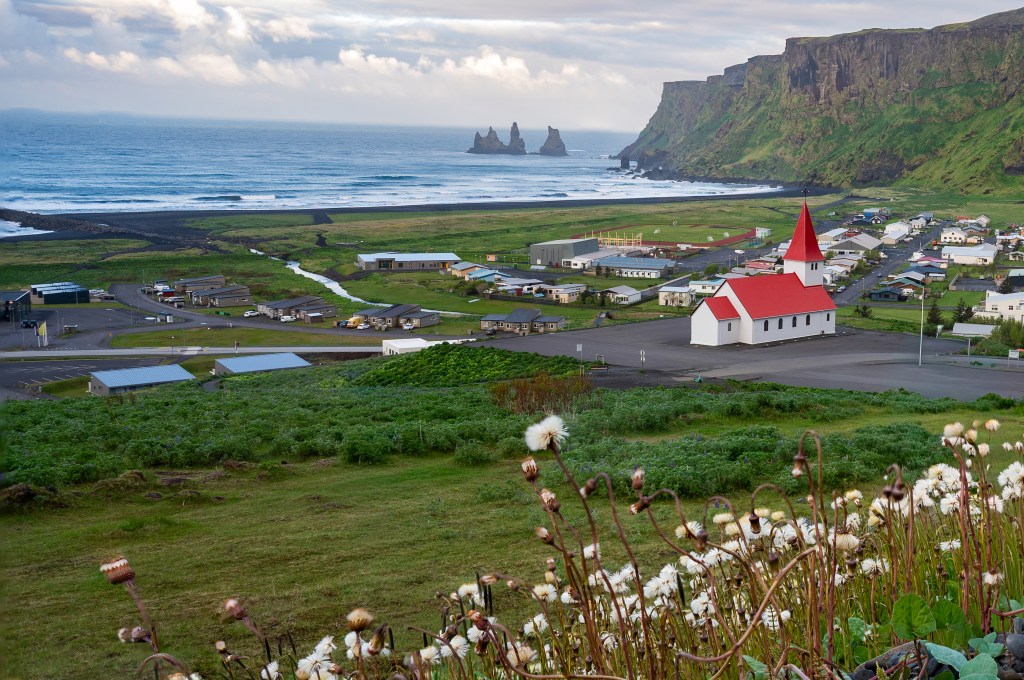
The next morning, before leaving Vík, we hiked up a trail just behind our hotel. From the top, we got sweeping views of the village, the vast sea, the black sand coastline and the beautiful red-roofed church.
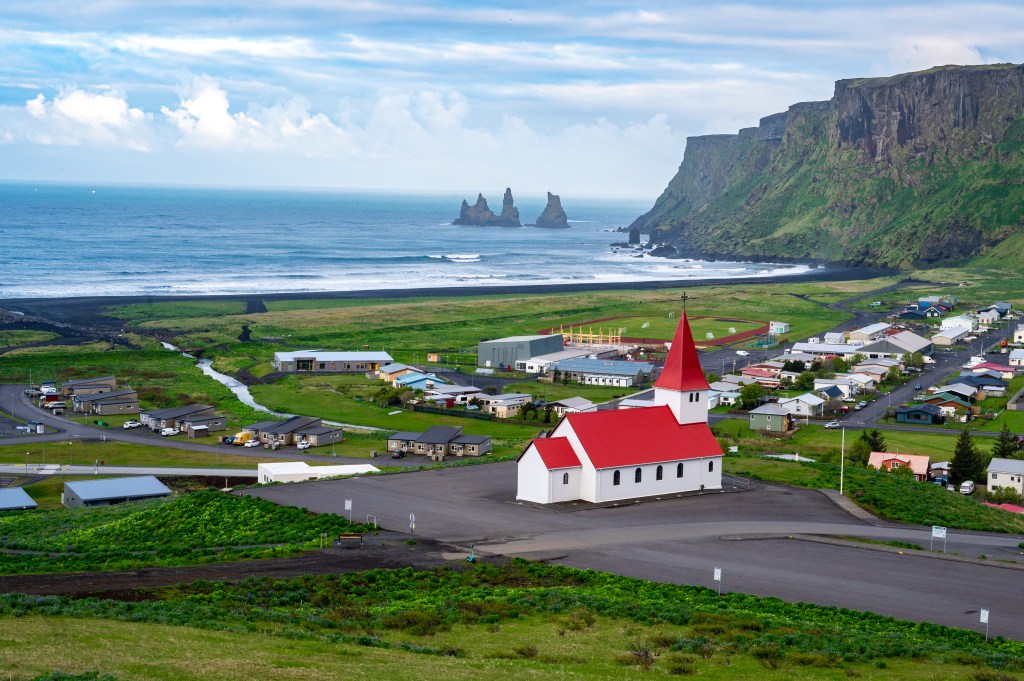
The early morning light, silence and dramatic setting made it feel almost meditative.
If this does not please your eyes, I doubt anything ever will.
Day 2 Summary
Route: Geysir → Seljalandsfoss → Gljúfrabúi → Skógafoss → Dyrhólaey → Reynisfjara → Vík
Approximate drive time: 3 to 4 hours, excluding stops
Hotel stay: Hotel vik i myrdal
Highlights: Geysir morning walk, Seljalandsfoss, Gljúfrabúi, Skógafoss, Dyrhólaey, Reynisfjara, Vík morning hike
Day 2 was wet, windy, dramatic and unforgettable.
In short, it was Iceland doing what Iceland does best — changing its costume every few hours and making sure you keep watching.
Day 3: Vík to Höfn
Glacier Country, Svínafellsjökull, Jökulsárlón Glacier Lagoon and Diamond Beach
Iceland is like a mind-boggling Netflix mystery thriller series, where every episode ends on a cliffhanger and the next episode is even better.
You finish one day thinking, “Surely, nothing can be more beautiful than this.”
And then Iceland smiles quietly and says, “Wait for tomorrow.”
Fjaðrárgljúfur Canyon — The Name We Gave Up Pronouncing
After leaving Vík, our first stop was Fjaðrárgljúfur Canyon.
Or, as we lovingly called it, “that canyon whose name no sane traveller should attempt pronouncing without medical supervision.”
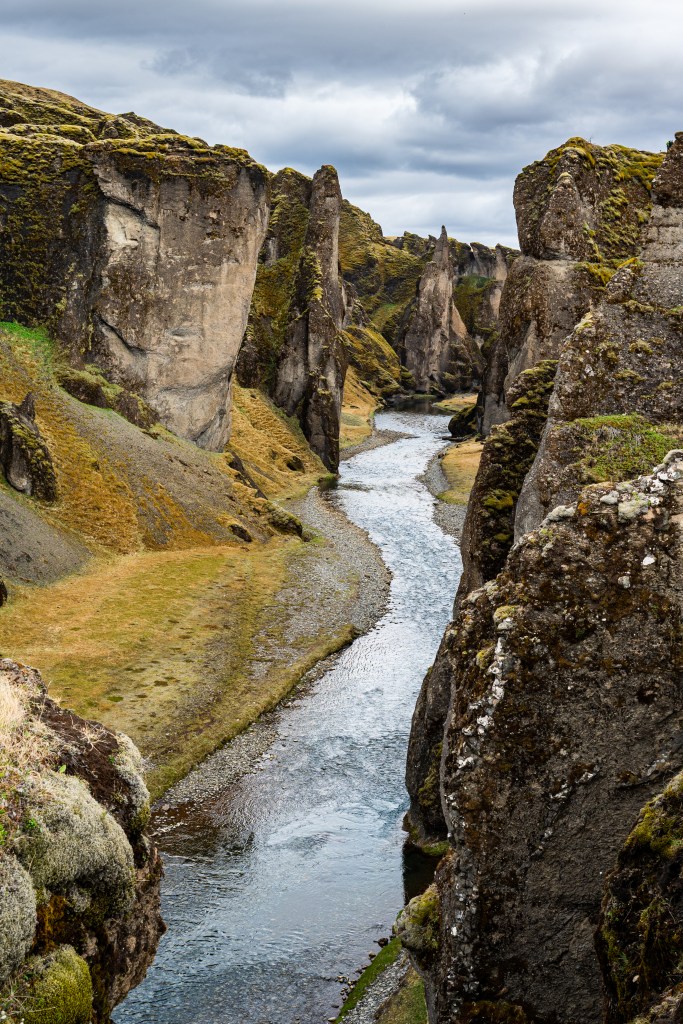
But difficult name apart, this place was absolutely worth the stop.
Fjaðrárgljúfur is a beautiful canyon with steep green walls, a winding river below and dramatic viewpoints along a simple walking trail. The hike is not difficult at all. A short walk takes you to a couple of viewpoints, and with every viewpoint the canyon reveals itself a little more.
And then you are simply mesmerized.
The way the river curves through the canyon, the depth of the gorge, the green slopes, the silence and the scale of the landscape together make it feel like nature has carved out a private masterpiece and casually placed it beside the road.
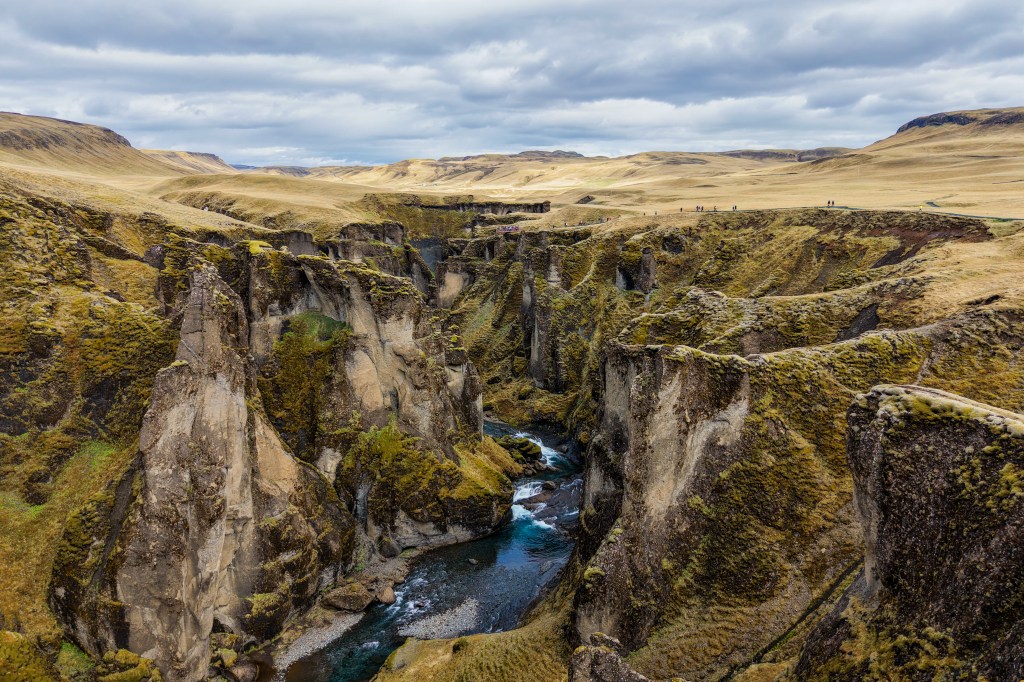
It does not demand too much effort from you.
Just a short walk.
And in return, it gives you a view that stays in your memory for a long time.
For us, Fjaðrárgljúfur was the perfect first stop after Vík — easy, beautiful and wonderfully dramatic without being tiring.
What followed was one of the most dramatic landscape days of our entire trip with major highlights being Vatnajökull Glacier, along with Jökulsárlón Glacier Lagoon and Diamond Beach.
Before travelling, we had seen countless photographs of Jökulsárlón and Diamond Beach online. We knew they would be among the highlights of our Iceland trip.
But what we had not anticipated was the drive itself.
Driving Into Glacier Country
As we left Vík and moved further east, the landscape slowly started changing again.
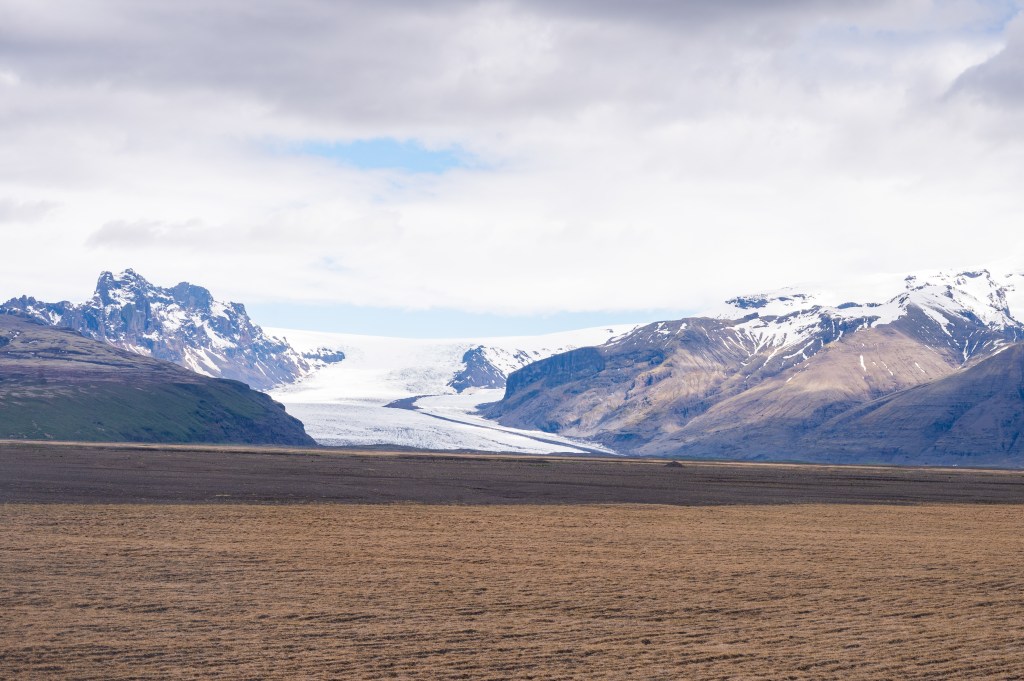
The black sand, cliffs and coastal drama of the previous day began giving way to vast open spaces and distant icy mountains. And then, almost suddenly, the road opened up to a grand glacier view in front of us.
This was our first real experience of Vatnajökull, the largest glacier in Iceland.
Two glacier tongues in particular dominate this region — Skaftafellsjökull and Svínafellsjökull. These are outlet glaciers flowing down from the massive Vatnajökull ice cap.
From the road, it looked as if the great glacier was spreading its arms through these icy tongues and gently embracing the land around it.
It was majestic.
No photograph had prepared us for the scale of it.
Svínafellsjökull Glacier
Our first major glacier stop was Svínafellsjökull.
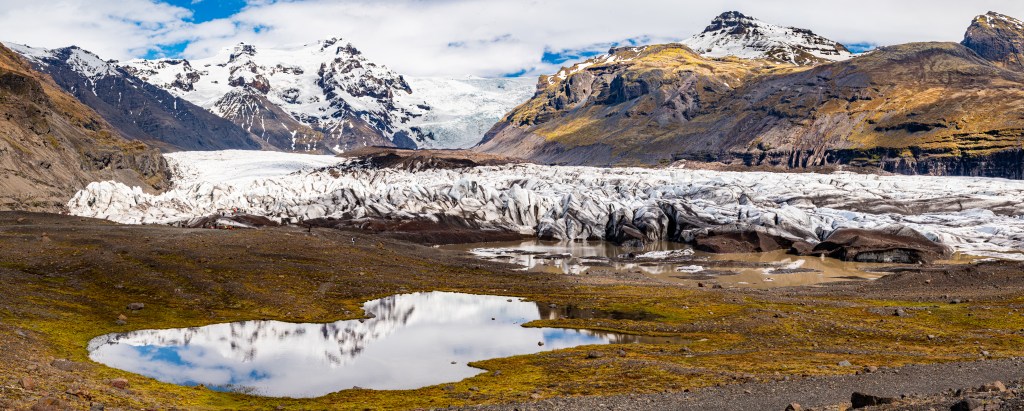
This place is a photographer’s delight. The glacier, mountains, rugged terrain and changing light create endless photo opportunities. We had planned to spend limited time here, but Iceland had other ideas.
Or rather, our cameras had other ideas.
We became so engrossed in clicking photographs that, within the time we had, we could hardly reach close to the glacier itself.
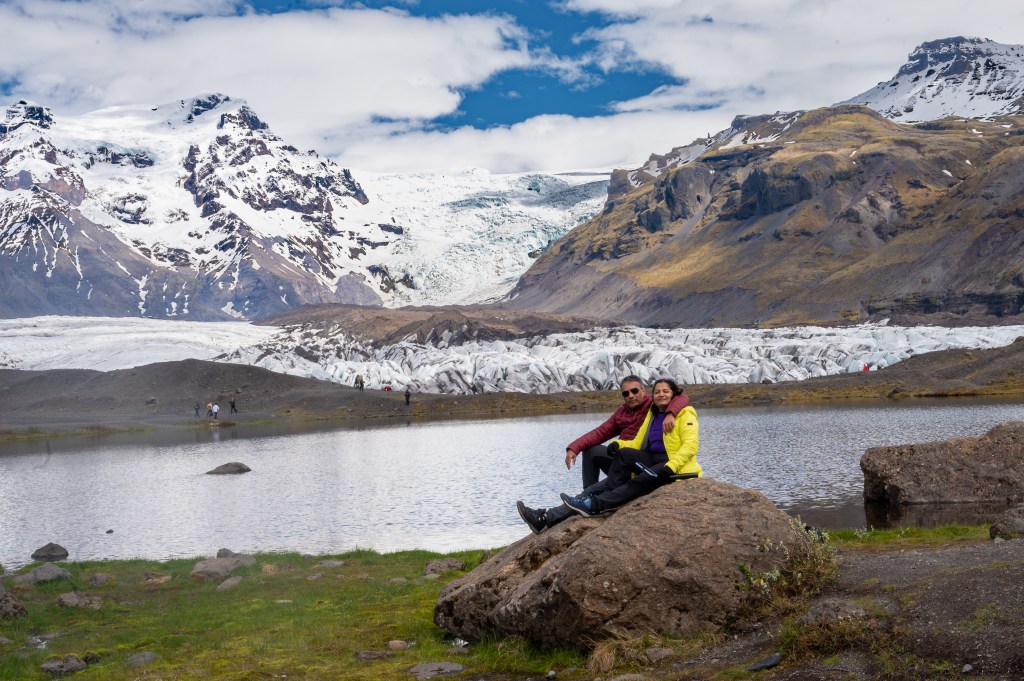
And once again, the main villain of our journey appeared.
The clock.
Despite our repeated requests, it refused to halt even for a while. In fact, it seemed to run at full throttle exactly when we needed it to slow down.
Glacier walking was something we decided to keep marked for a future Iceland trip. Some experiences deserve unhurried time, and this felt like one of them.
Jökulsárlón Glacier Lagoon
The drive from the glacier region towards Jökulsárlón was absolutely stunning.
The road itself became part of the experience. You are not just going to a destination; you are surrounded by the destination all along the way.
As we approached Jökulsárlón, the excitement started building.
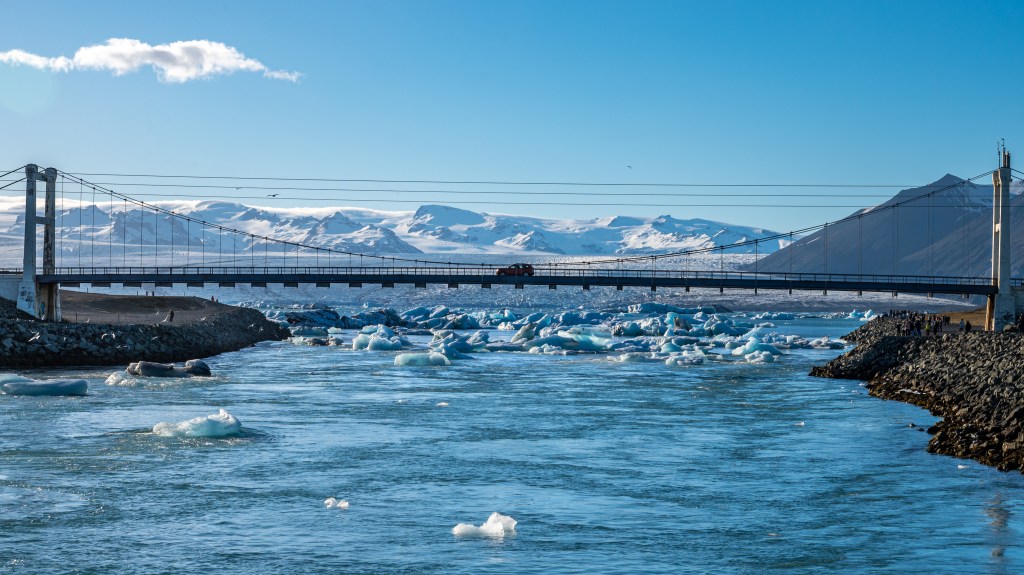
The glacier lagoon became visible on the left just after we crossed the bridge. On the right side was the famous Diamond Beach.
It is rare to have two world-class natural wonders sitting almost opposite each other across a road.
But this is Iceland.
It does not believe in doing things modestly.
The lagoon was filled with floating icebergs of different shapes, sizes and shades. Some were white, some had deep blue streaks, and some looked like pieces of sculpture drifting slowly across the water.
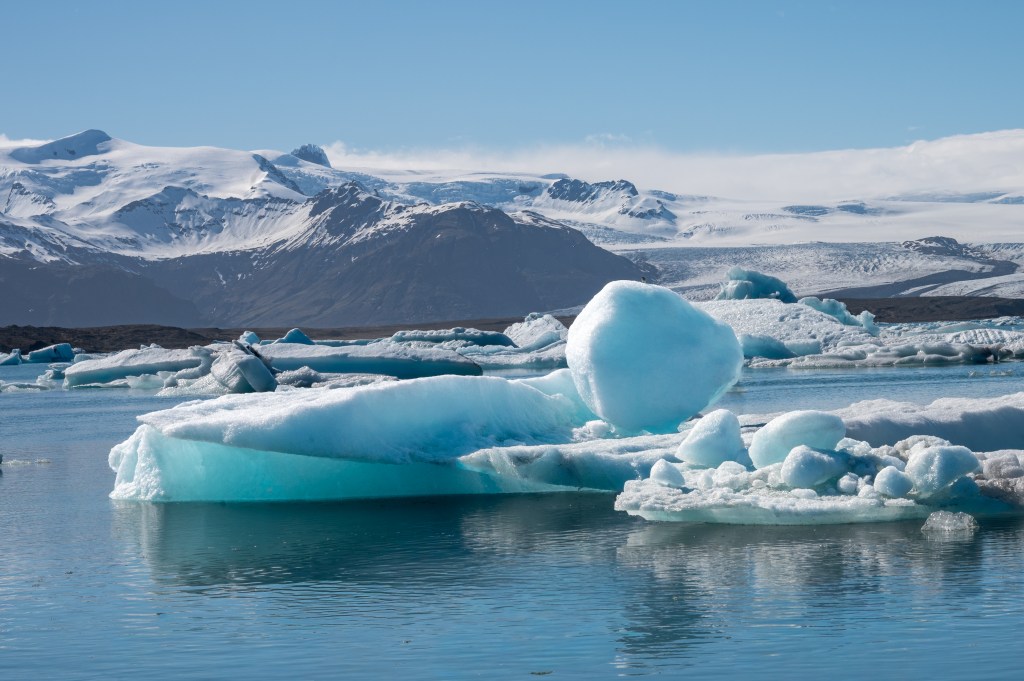
Behind them, the glacier stood in the distance.
It was surreal.
Zodiac Boat Tour at Jökulsárlón
We had booked a Zodiac boat tour at Jökulsárlón, and it was worth every penny — and some more.
Unlike the larger amphibian boats, the Zodiac boats are smaller and faster, allowing you to go deeper into the lagoon and closer to the glacier while maintaining a safe distance. You are given warm flotation suits before the ride, which are very useful because the air becomes quite cold once you are out on the water.
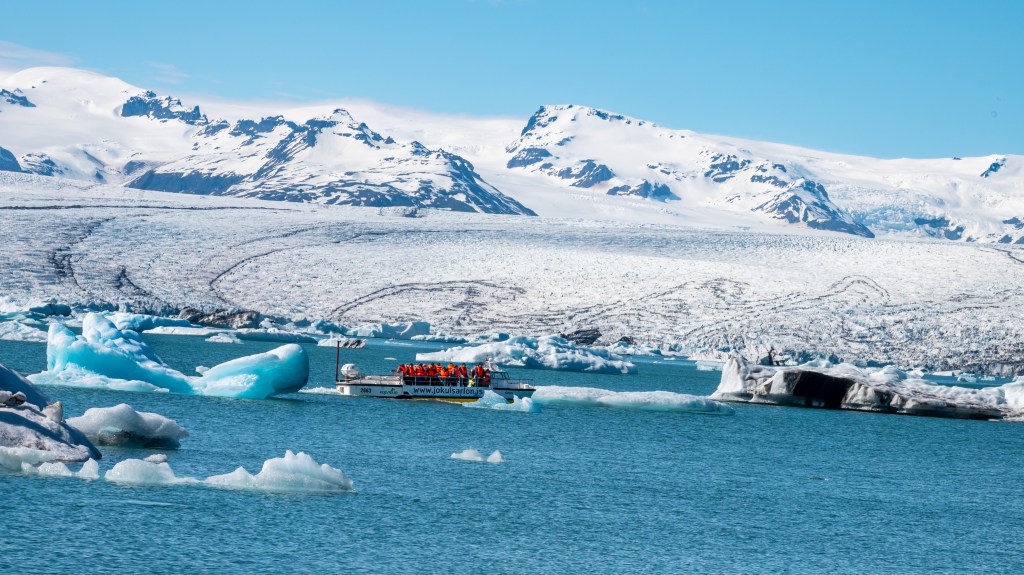
The tour took us right into the heart of the lagoon, with icebergs floating all around us.
Our guide explained how the glacier is receding due to climate change. Listening to that while actually sitting in front of the glacier made the issue feel very real. It was no longer just something written in articles or shown in documentaries.
It was right there in front of us.
Melting. Retreating. Changing.
We also saw a couple of seals swimming near the icebergs, which added another layer of excitement.
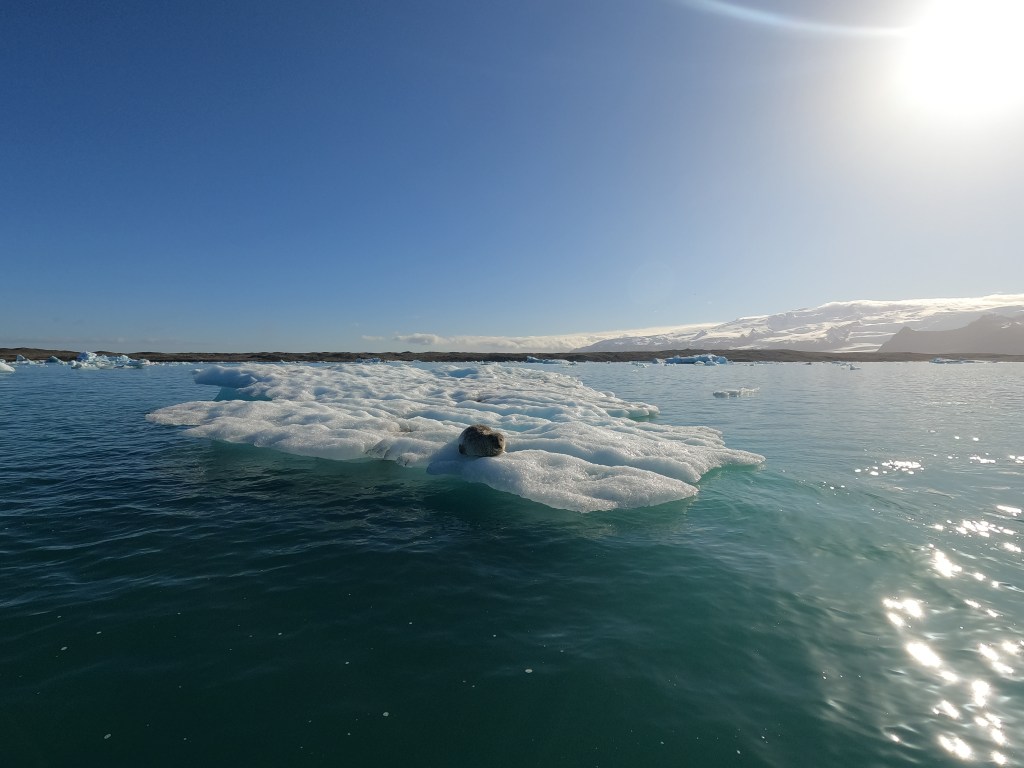
The blue icebergs, the massive glacier, the cold breeze, the stillness of the lagoon and the quiet movement of the boat together created pure magic.
There are some travel experiences where you do not feel like talking much.
You just look.
And thank God repeatedly for giving you a pair of eyes to witness such a natural marvel.
Diamond Beach
After returning from the boat tour, we crossed over to Diamond Beach.
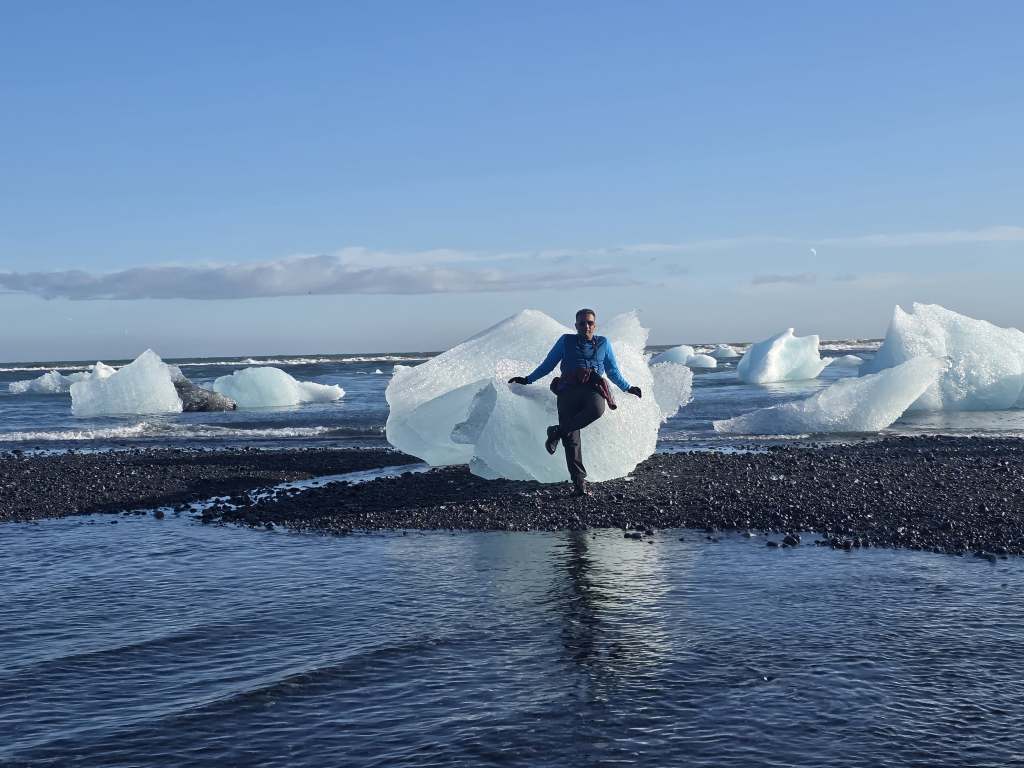
And honestly, where else on earth do you find small icebergs scattered across a black sand beach, sparkling like diamonds?
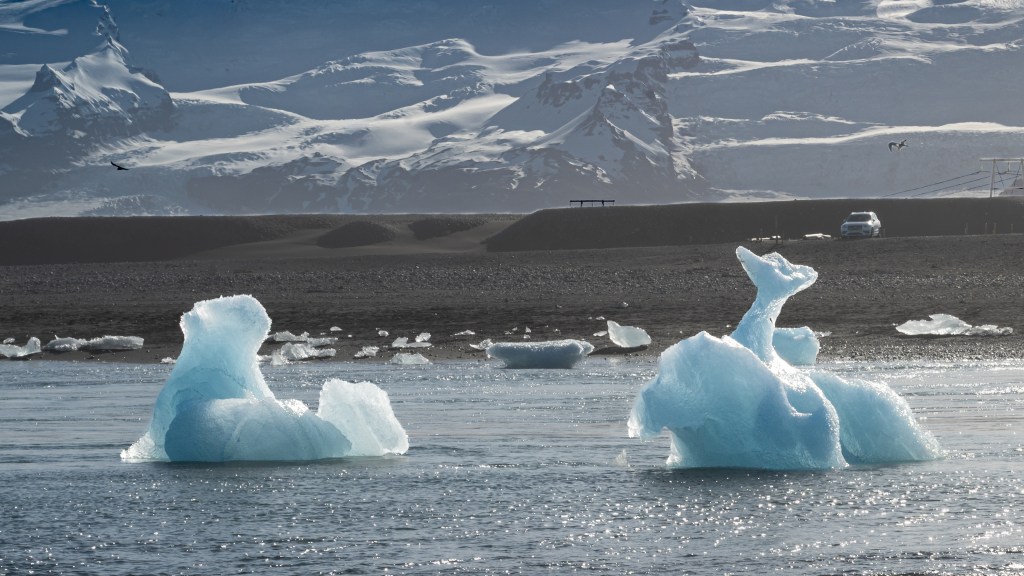
The icebergs from the glacier lagoon slowly drift out to sea, and some wash back onto the black volcanic sand. The contrast is extraordinary — crystal-like ice pieces lying on deep black sand, with waves crashing around them.
Some pieces were small and transparent. Some were blue. Some looked like glass sculptures. Some looked like jewels left behind by the ocean.
No wonder it is called Diamond Beach.
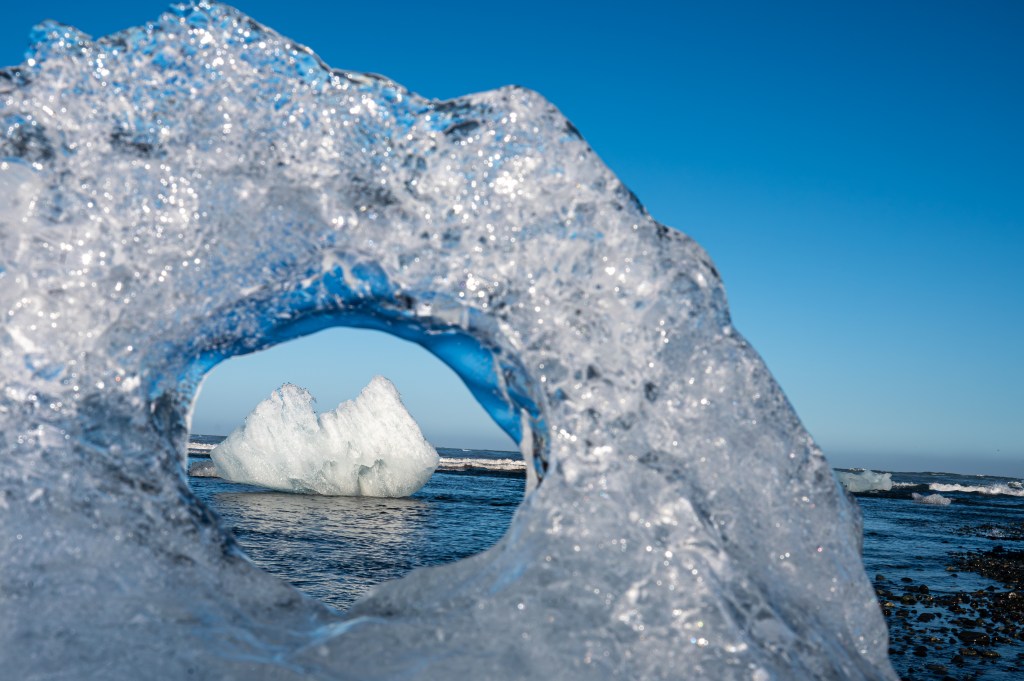
After exhausting our SD cards, camera batteries and probably our family’s patience for “just one more photo,” we finally moved on.
Towards Höfn
Our halt for the night was Berjaya Hotel in Höfn.
The drive towards Höfn gave us time to quietly process what we had seen during the day. It had been one of those rare travel days where the actual experience exceeded even the imagination created by photographs.
As we drove away, one thought stayed with us.
With climate change affecting glaciers across the world, where would this glacier be when we return to Iceland next?
That thought added a little sadness to the beauty.
Because places like this are not just to be seen.
They are to be respected, protected and remembered.
Day 3 Summary
Route: Vík → Fjaðrárgljúfur Canyon →Svínafellsjökull → Jökulsárlón Glacier Lagoon → Diamond Beach → Höfn
Approximate drive time: 3.5 to 4.5 hours, excluding stops
Hotel stay: Berjaya Hotel, Höfn
Highlights: Fjaðrárgljúfur Canyon, Glacier landscapes, Svínafellsjökull, Jökulsárlón Zodiac boat tour, seals, Diamond Beach
Day 3 was glacier day.
If Day 2 was cinematic, Day 3 was spiritual.
This was Iceland at its most dramatic, most fragile and most unforgettable.
Day 4: Höfn to Seyðisfjörður
Vestrahorn, East Fjords and the Fairytale Drive to Seyðisfjörður
Day 4 was Iceland behaving like a quiet artist — less famous, less crowded, but painting some of the most soulful landscapes of the trip.
After Day 3, we were quite sure of one thing.
Nothing would beat Jökulsárlón Glacier Lagoon and Diamond Beach.Like ever.
But Iceland clearly enjoys challenging human confidence.
Because the very next day, it made us question that thought.
Most tourists visit Reykjavík, do the Golden Circle, drive along the South Coast and reach up to Jökulsárlón. The crowds are quite thick till this region. And yes, that part of Iceland is spectacular. But beyond the glacier lagoon, as you move towards the East Fjords and then towards North Iceland, the country begins to reveal a different personality.
This is where the raw beauty lies.
This is where Iceland becomes quieter, wilder and more rustic.
Morning in Höfn
For us, Höfn was supposed to be just a transit stay.At least that was the plan.
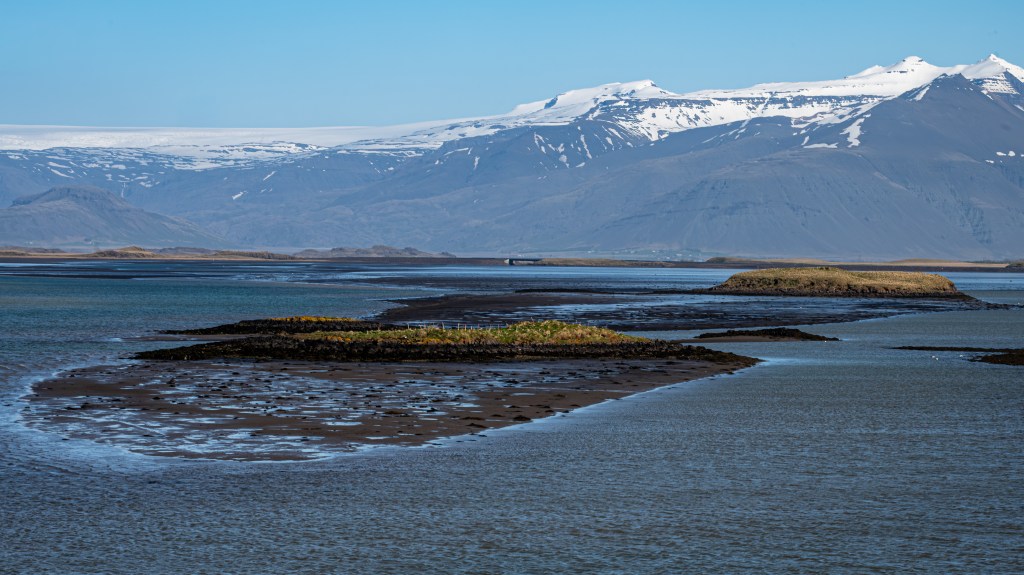
But Iceland has a habit of making even transit towns look like destinations.
Höfn is a small town surrounded by lovely landscapes, with mountains, open skies and coastal views all around. The morning gave us a chance to explore at our own pace before starting the drive towards the East Fjords.
And of course, the Icelandic wind returned in full force.
By now, the wind was no longer a surprise. It had become an unofficial travel companion — slightly irritating, occasionally dramatic, but somehow adding character to every place.
Vestrahorn — Beyond Expectations
Our first major stop of the day was Vestrahorn.
After paying an entry fee — though in Iceland, nothing is truly small when converted into rupees — we entered this private property near Stokksnes.
Vestrahorn was already high on our expectations list. The famous Bollywood song Gerua had done its work well, and like many Indian travellers, we had seen enough dreamy shots of the place to be excited.
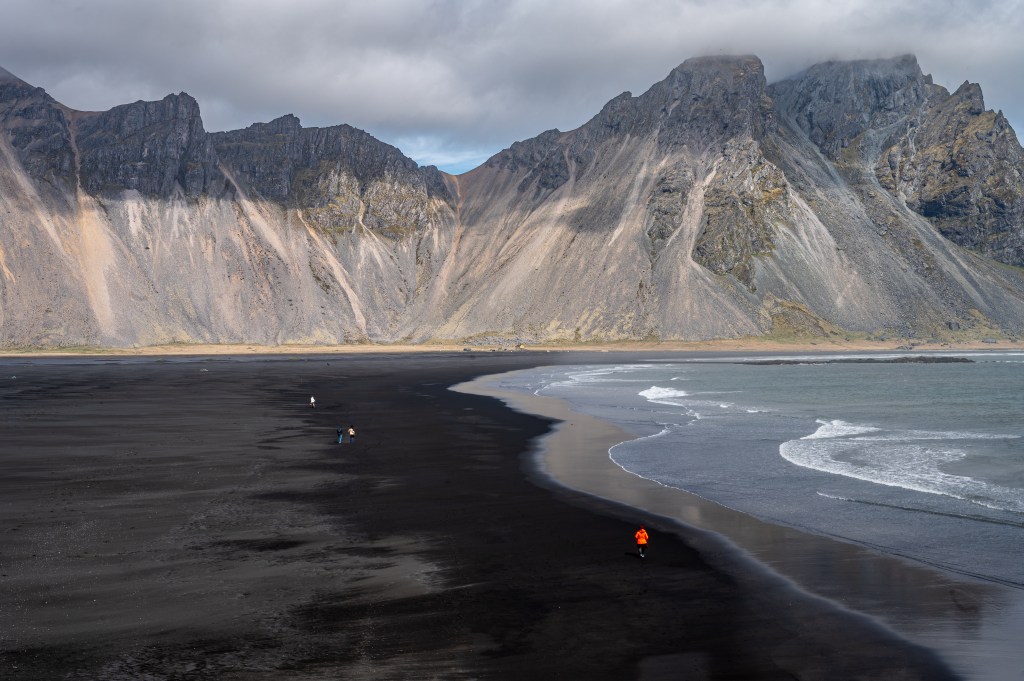
But even then, the actual experience went beyond imagination.
The black sand, dramatic mountain backdrop, wind-shaped dunes and mirror-like reflections created a landscape that felt unreal. The sharp peaks of Vestrahorn rising behind the dark foreground gave the whole place an almost cinematic mood.
This was not the soft beauty of a lake or a meadow.
This was bold, moody and powerful.
For photography, Vestrahorn was one of the best places of the entire trip. Some of my favourite photographs from Iceland were taken here. The reflections, textures, layers and mountain shapes gave endless compositions.
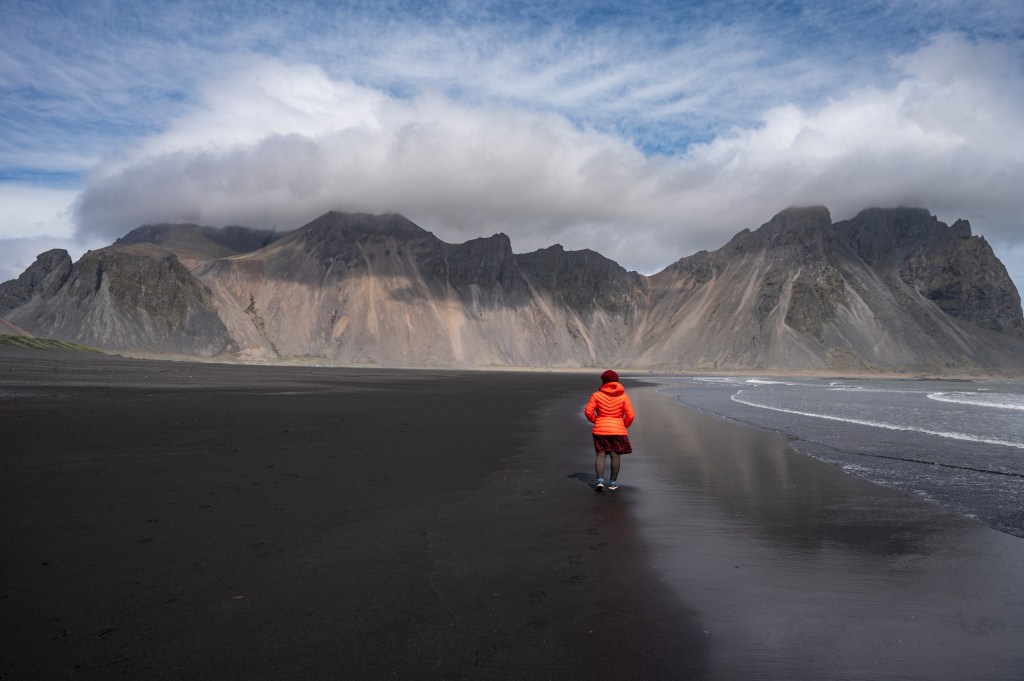
After spending a very satisfying time there, we had lunch near the entry area. Once again, soups came to our rescue. In Iceland’s cold and windy weather, soup becomes less of a meal and more of an emotional support system.
Entering the East Fjords
From Vestrahorn, we began our drive into the East Fjords.
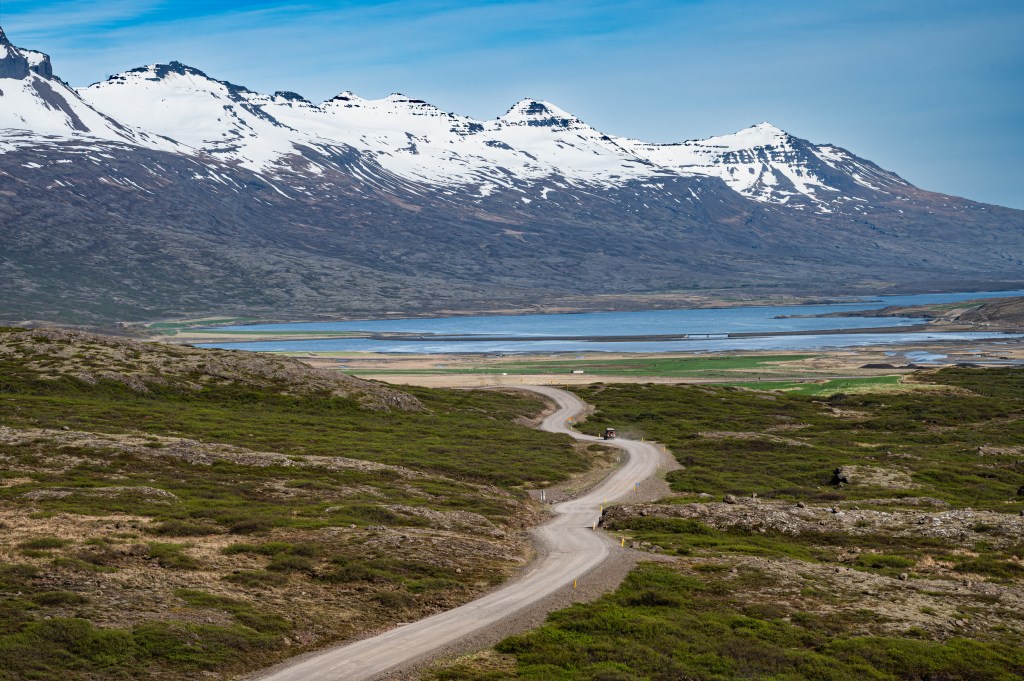
This stretch is very different from the South Coast. The famous waterfalls and glacier lagoons are now behind you, and the landscape becomes more remote, open and rugged. The road winds along mountains, coastal edges and fjords, with the sea appearing on one side and dramatic slopes on the other.
The beauty here is not concentrated at one single attraction.
It is spread across the entire drive.
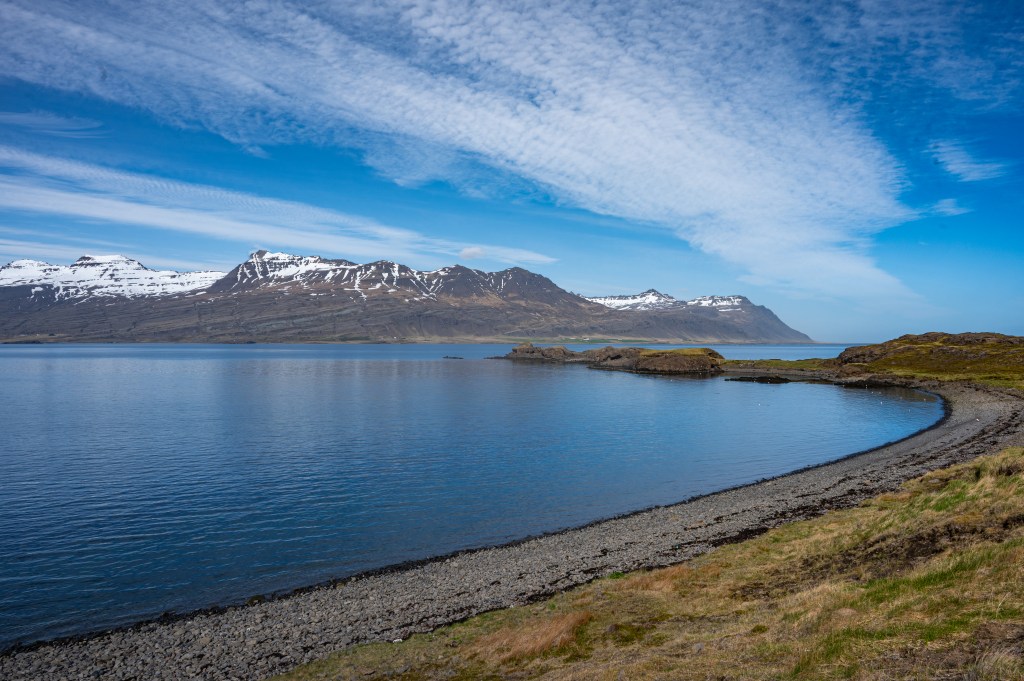
This is the kind of road where you want to stop every five minutes. A mountain here, a curve there, a coastal village suddenly appearing, a patch of snow on the slopes, a sheep looking at you as if it owns the country — everything feels worth photographing.
Somehow, after resisting the temptation to pull over constantly, we continued towards Egilsstaðir.
But the best was still waiting.
Egilsstaðir to Seyðisfjörður — One of the Best Drives of the Trip
The drive from Egilsstaðir to Seyðisfjörður was one of the most beautiful road stretches of our entire Iceland journey.
This is a short drive, but what a drive it is.
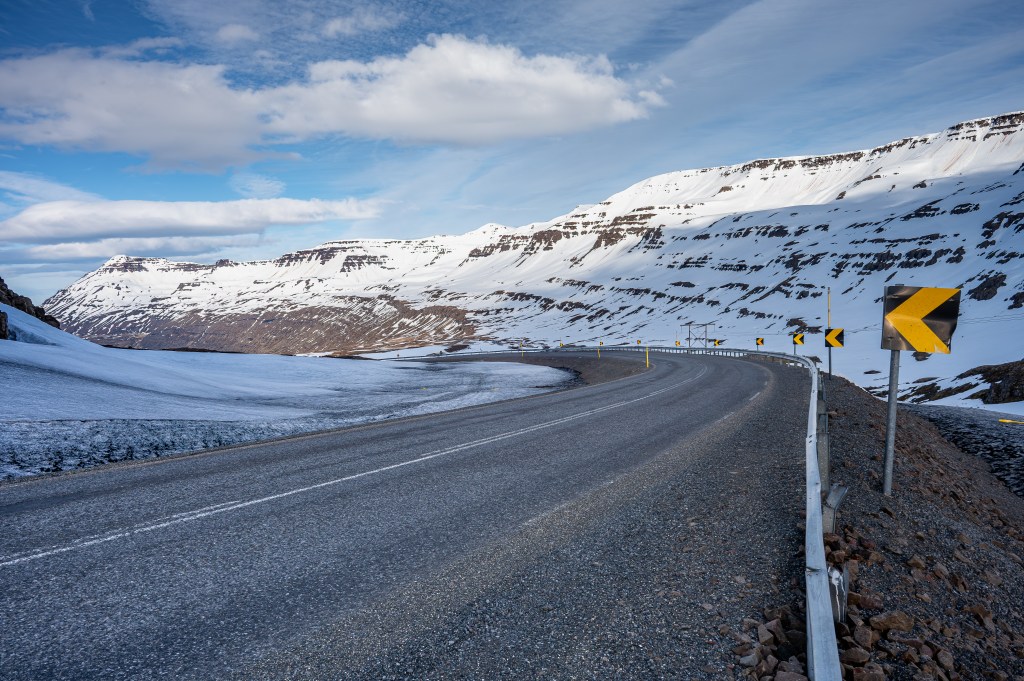
As the road climbs out of Egilsstaðir, the landscape begins to change dramatically. Snow-covered fields, mountain slopes, frozen lakes and wide open views appear one after another. The road then descends towards Seyðisfjörður, slowly revealing the tiny village tucked between mountains and the fjord.
It feels like entering a fairytale.
The frozen lake, the snow patches, the winding road and then the sudden appearance of this colourful little town by the water — it is something that has to be experienced in person.
No photograph can fully capture the feeling of that descent.
Seyðisfjörður — A Fairytale Town
Seyðisfjörður was one of the best towns I have ever visited.
And I have visited a few.
This tiny town could easily give a run for money to any Swiss lakeside village, Dolomite town, French countryside village or Scottish island settlement.
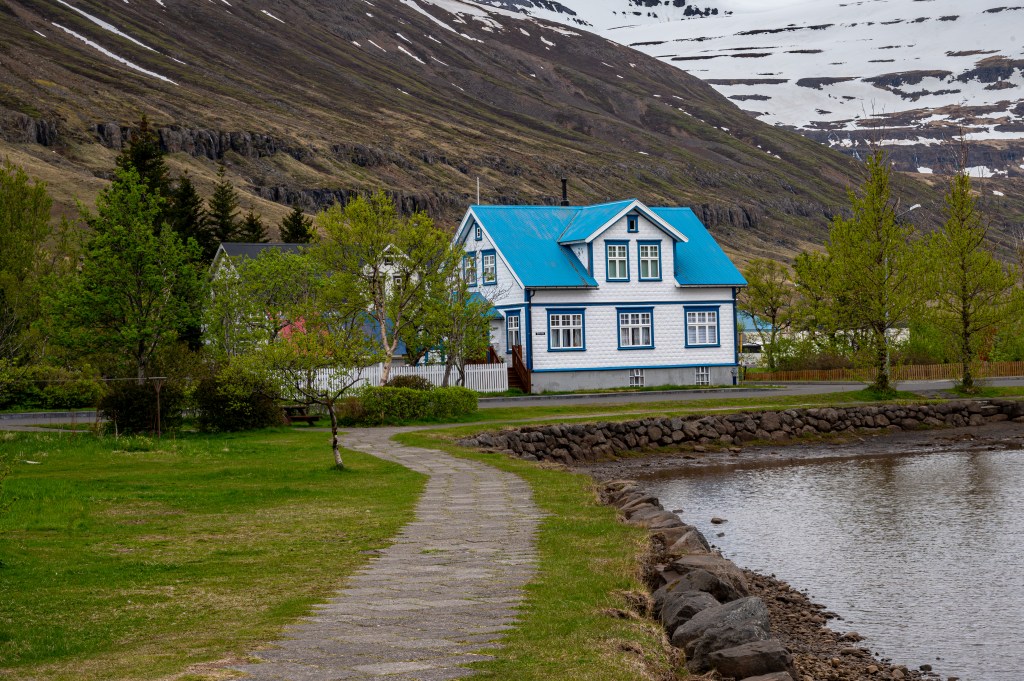
It has everything — mountains, waterfalls, colourful houses, a charming church, a rainbow street, a peaceful fjord and a calmness that is difficult to describe.
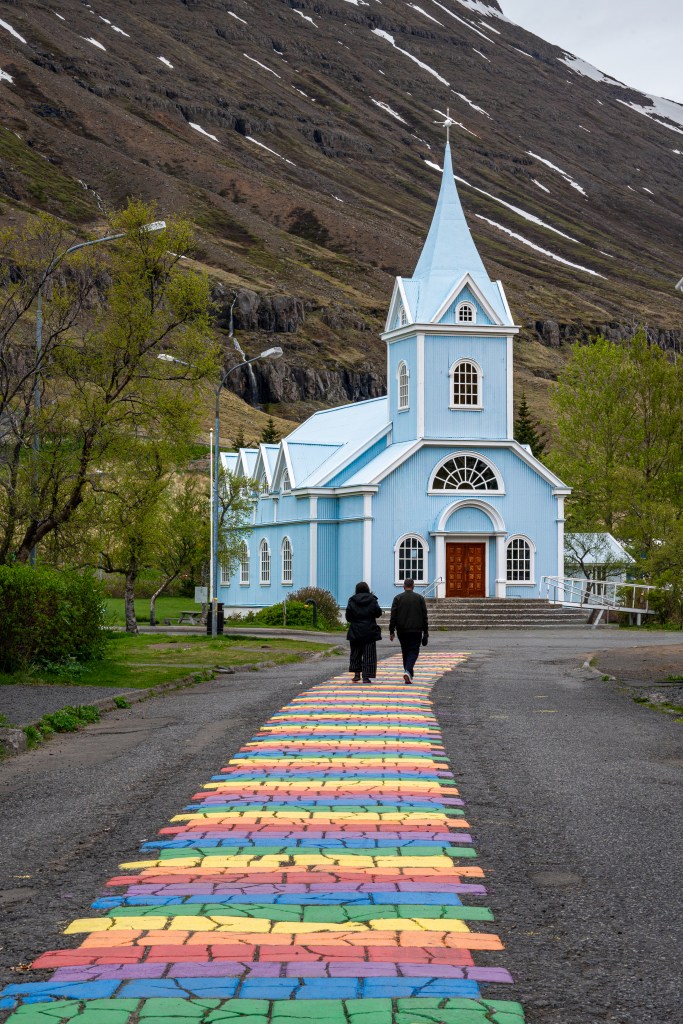
Since we did not have too many major sightseeing targets for the day, we reached Seyðisfjörður early. This gave us time to explore the town slowly, and that was exactly how this place deserved to be experienced.
Our stay was at Hotel Aldan, a small guesthouse-style hotel. The room was compact — just about enough for two of us, with our bags squeezing in like extra family members. But the location was straight out of a dream.
And in a town like Seyðisfjörður, location matters more than room size.
You do not come here to sit inside the hotel room.
You come here to walk, breathe, look around and wonder how such a small place can feel so complete.
Walking Through Peace
We walked through the town at our own pace.
The famous blue church with the rainbow street in front is the postcard image of Seyðisfjörður, and it is every bit as charming in real life. But what makes the town truly special is not just that one view.
It is the setting.
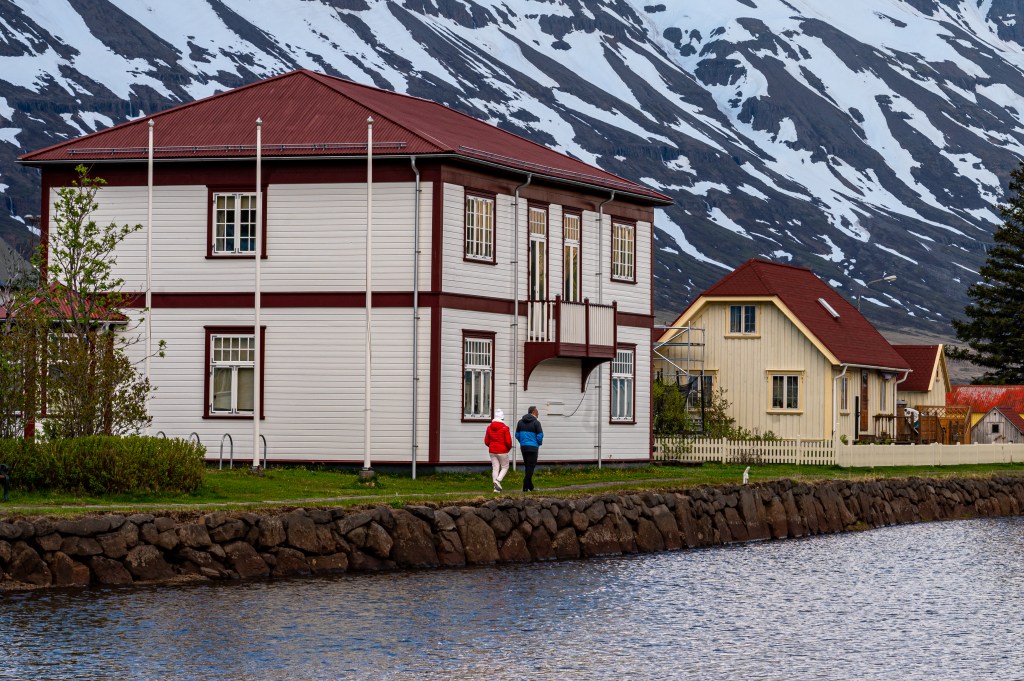
Waterfalls seem to fall from the mountains all around. The fjord sits quietly at the edge of the town. Colourful houses are scattered gently across the landscape. The streets are calm. The air feels still. The pace of life appears wonderfully slow.
We explored a couple of nearby waterfalls, but honestly, the destinations were almost namesake.
We were not walking to reach somewhere.
We were just walking in peace.
And that was the real experience of Seyðisfjörður.
No rush.
No checklist.
No crowd.
No noise.
Just mountains, water, waterfalls, wind and silence.
Breakfast at Hotel Aldan
The next morning, Hotel Aldan gave us another reason to remember Seyðisfjörður fondly.
The breakfast was delicious and easily one of the best of our Iceland trip. The spread was fresh, warm and satisfying, but the real star was the cinnamon roll.
It was as good as, or maybe even better than, the famous Brauð & Co. cinnamon rolls in Reykjavík.That is not a casual compliment. In Iceland, cinnamon rolls are serious business — and this one deserved full respect.
A peaceful town, a dreamy location and a breakfast like that?
Seyðisfjörður clearly knew how to say goodbye.
Day 4 Summary
Route: Höfn → Vestrahorn/Stokksnes → East Fjords → Egilsstaðir → Seyðisfjörður
Approximate drive time: 4.5 to 5.5 hours, excluding stops
Hotel stay: Hotel Aldan, Seyðisfjörður
Highlights: Vestrahorn, East Fjords drive, Egilsstaðir to Seyðisfjörður mountain road, blue church, rainbow street, Hotel Aldan breakfast
Day 4 reminded us that Iceland’s biggest treasures are not always the most famous ones.
If South Iceland was grand and famous, East Iceland was quiet and soulful.
Continuing beyond Jökulsárlón was not just a good decision.
It was one of the best decisions of the entire trip.
Day 5: Seyðisfjörður to Mývatn
Stúdlagil Canyon, Snowy Roads, Dettifoss and Geothermal North Iceland
Day 5 was Iceland turning into a moody black-and-white art film — snow, clouds, basalt, waterfalls, steam and just enough drama to keep everyone awake.
Morning Walk to Vestdalsfossar
Before leaving Seyðisfjörður, we decided to explore Vestdalsfossar, just a few kilometres down the road.
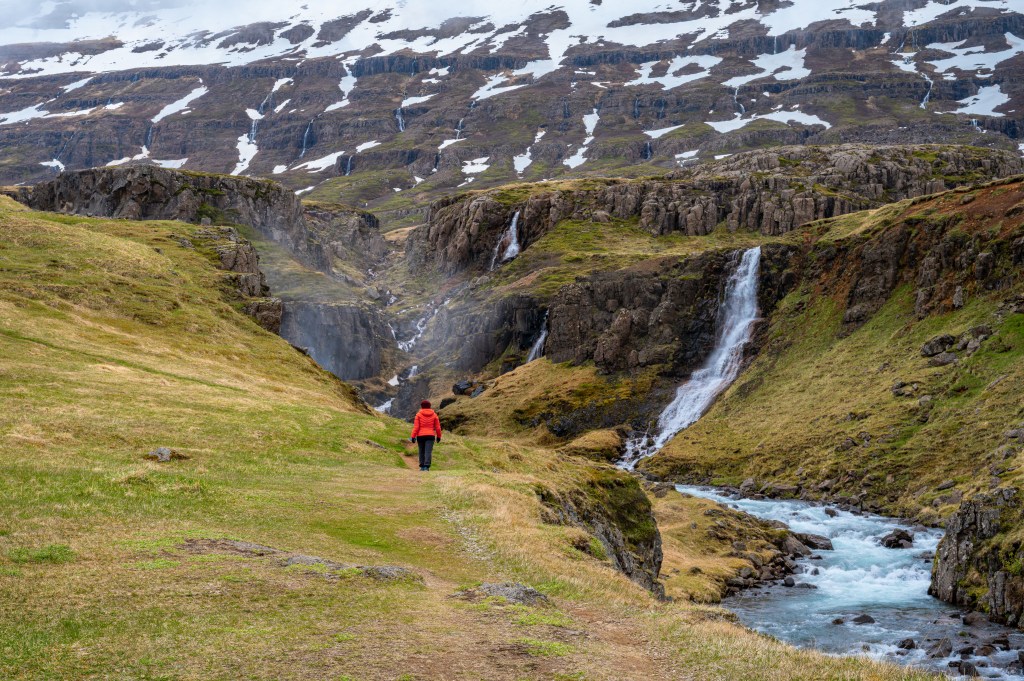
The weather was cloudy and rainy, but the short hike was absolutely worth it. Vestdalsfossar is actually part of a longer hiking trail, and if you have more time, you can continue further into the valley. But once again, our time gods refused to budge.
They had been very strict throughout the trip.
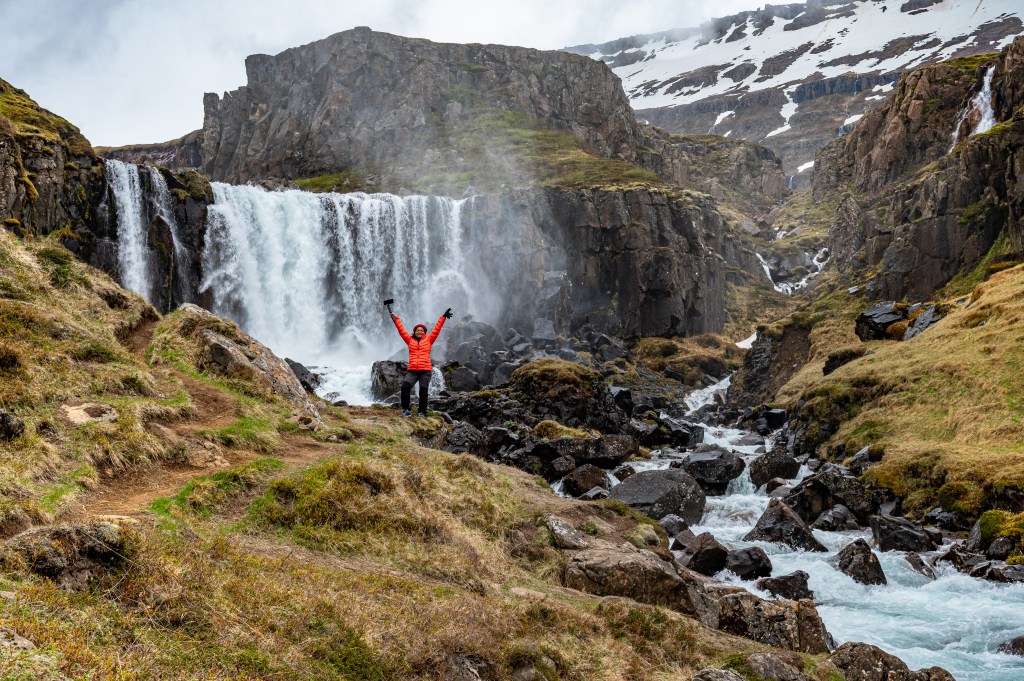
The short walk gave us a lovely last taste of Seyðisfjörður’s quiet beauty — waterfalls, mountain slopes, cloudy skies and that peaceful fjord-town atmosphere. It was the perfect goodbye to one of our favourite places in Iceland.By Day 5, Iceland had already shown us waterfalls, glaciers, black beaches, fjords and fairytale towns.
So naturally, it decided to change the script again.
This was the day when the weather gods, who had been fairly consistent till now, decided to add some spice to our journey.
Clouds, rain, sleet, snow, wind — everything arrived together like a badly disciplined orchestra. But in Iceland, even difficult weather has its own beauty. The snow, mist and grey skies added a completely different texture to the landscape.
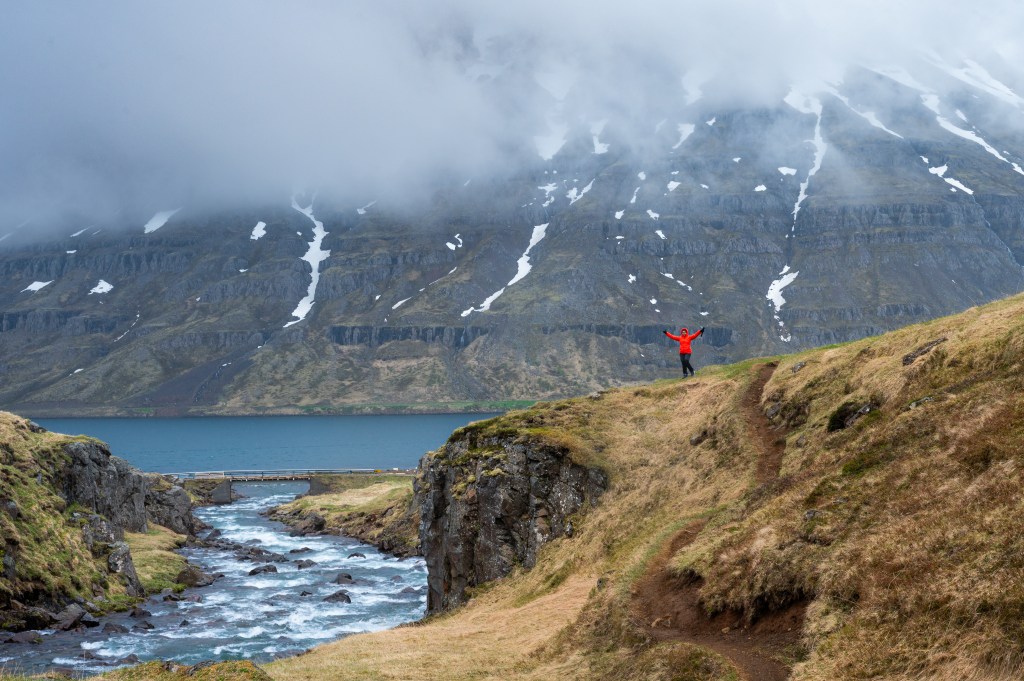
It was cold.
It was wet.
It was dramatic.
And strangely, it was beautiful.
Goodbye to Seyðisfjörður
Leaving Seyðisfjörður was not easy.
The town had become one of our favourite places in Iceland. After the wonderful breakfast at Hotel Aldan and that unforgettable cinnamon roll, we began our journey towards North Iceland with some reluctance.
The road climbed back from Seyðisfjörður towards Egilsstaðir, once again giving us those beautiful snowy mountain views, frozen lakes and wide open landscapes.
Even the exit from the town felt like a farewell scene from a movie.
Stúdlagil Canyon — Basalt, Blue Water and a Worthy Walk
On the way from Seyðisfjörður towards the Mývatn area, we visited Stúdlagil Canyon.
We parked at the east parking area, which involves a trail of roughly 5 km to and fro. It is not a difficult hike, but it does take time. However, the eastern side gives a much better view and access to the canyon, so the effort is absolutely worth it.
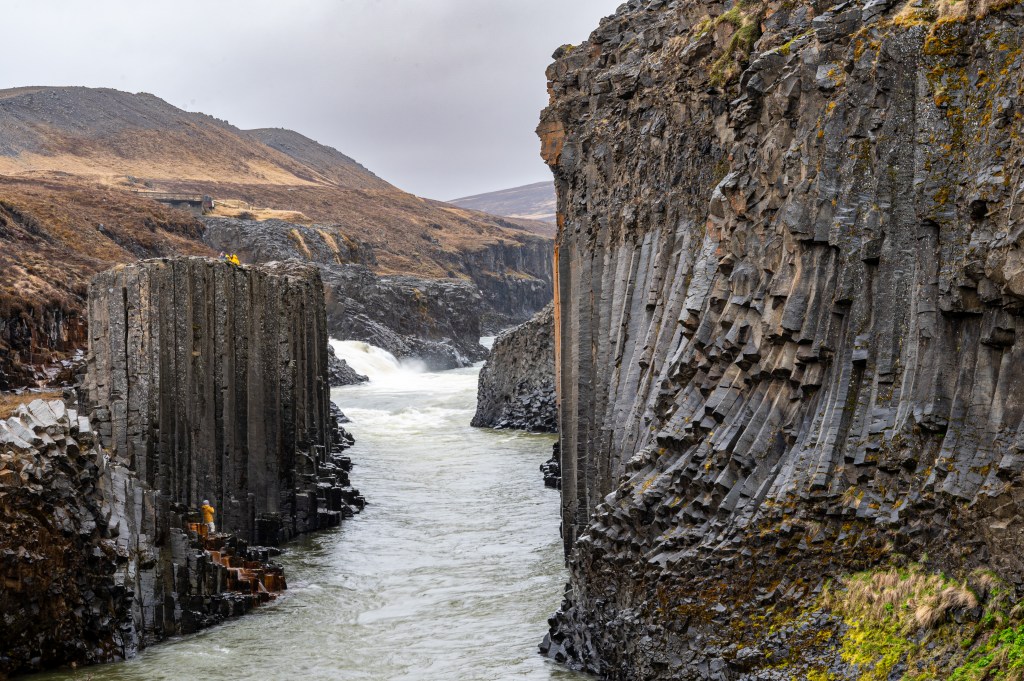
Stúdlagil is famous for its tall basalt columns and striking blue-green glacial river flowing between them. The entire canyon looks almost unreal, as if nature decided to build a cathedral out of stone pillars and then casually placed a river through the middle.
The basalt columns rise sharply on both sides, creating wonderful textures and patterns. For photography, this place is a delight. The combination of dark basalt, coloured water and rugged landscape gives it a very different character from anything we had seen so far.
It is not as instantly loud or dramatic as Skógafoss or Jökulsárlón.
It is quieter.More architectural.More mysterious.
If you have the time and are comfortable with the walk, the east-side trail is definitely the better choice. It gives you the feeling of actually entering the landscape rather than just looking at it from a distance.
The Coldest and Wettest Drive of the Trip
After Stúdlagil, the weather became more dramatic.
There was snow in the forecast, and it certainly did not disappoint.
The roads, mountains and surrounding fields were covered with patches of white. The clouds hung low, the wind was sharp, and the entire landscape had a dreamy, winter-like feel. The white powdered snow against the dark volcanic earth created a beautiful contrast.
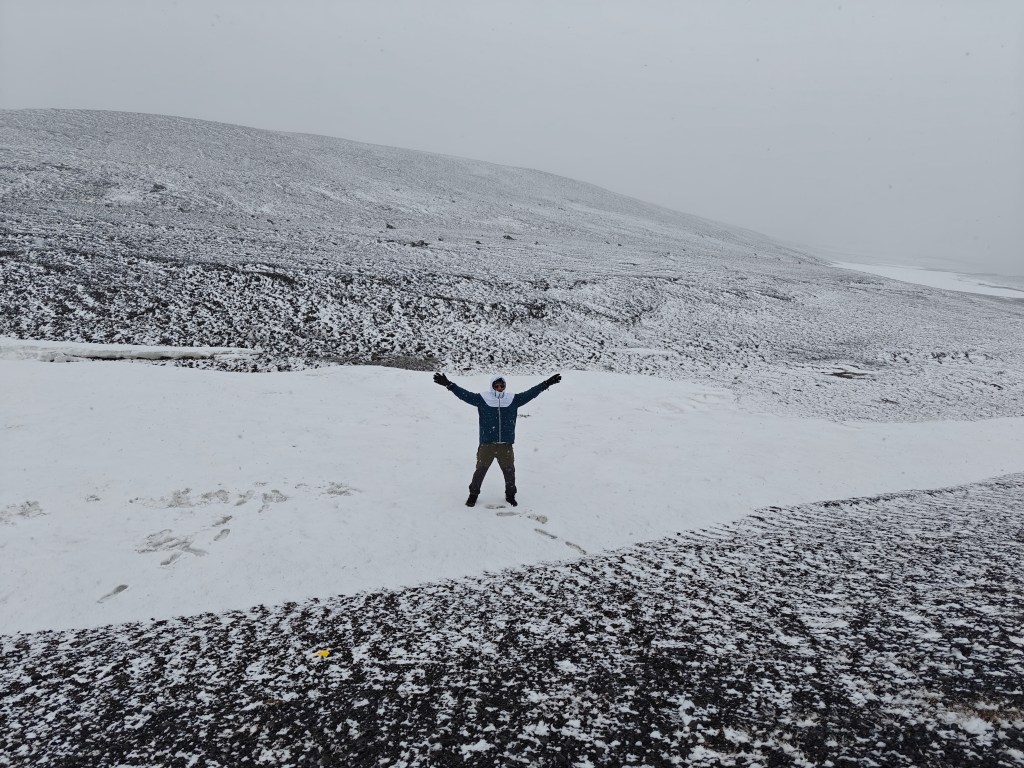
The weather was not easy, but it made the journey memorable.
Sometimes perfect blue skies are overrated. A little snow, a little discomfort and a little uncertainty can make the landscape feel more alive.
Of course, this also meant that driving required more attention. The roads were manageable, but the conditions reminded us that Icelandic weather should always be respected.
Especially on a self-drive trip, you cannot take the weather lightly.
Dettifoss — Power in the Snow
Our major waterfall stop of the day was Dettifoss, one of the mightiest waterfalls in Iceland.
If Gullfoss was powerful, Dettifoss felt almost prehistoric.
The weather made the experience even more dramatic. Snow overhead, wind howling, cold air cutting across the face — even the trail from the parking area to the viewpoint felt like a small challenge.
But that is the thing about Iceland.It makes you work a little, and then it rewards you generously.
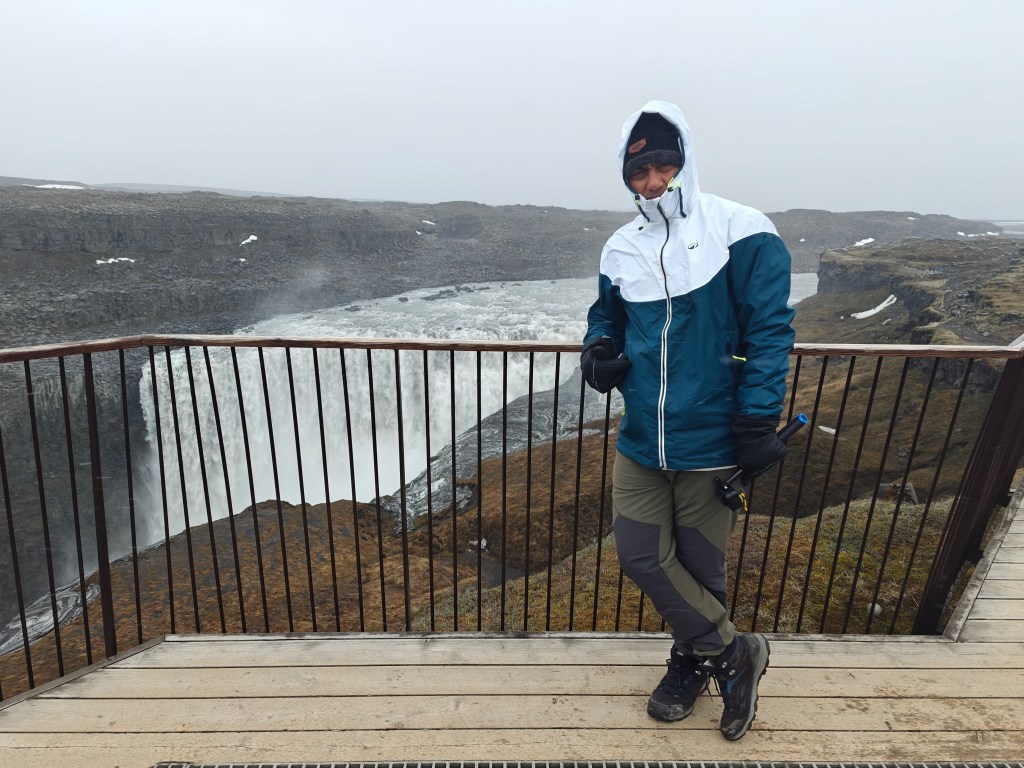
As we reached the viewpoint, the sheer force of Dettifoss made everything else fade away. The water thundered into the canyon with unbelievable power. Because of the low temperature, the mist rising from the waterfall seemed to turn into tiny snow-like particles in the air.
It felt raw and wild.
Not pretty in the delicate sense.
Dettifoss is not a gentle waterfall. It does not try to charm you. It overwhelms you.
This was Iceland showing its muscle.
Hverir Geothermal Area
After Dettifoss, we continued towards the Lake Mývatn region, where the landscape changed again.
On the way, we stopped at Hverir, the geothermal field near Námafjall.
This was yet another reminder that Iceland’s earth is very much alive.
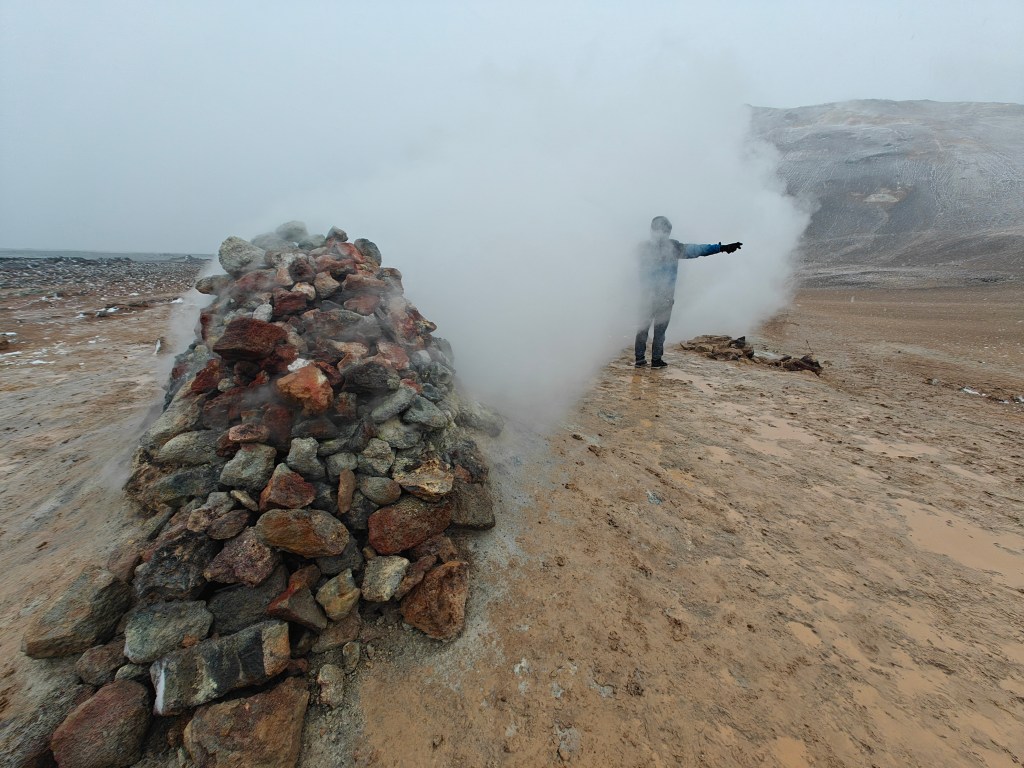
The boiling mud pots, steaming vents and sulphur-rich landscape make Hverir a fascinating stop. The ground looks raw and unstable, with steam rising from different corners and mud bubbling away as if the earth is cooking something below.
The colours are unusual — yellow, orange, grey, brown — and the smell of sulphur is strong enough to announce the place before you fully arrive.
It may not be everyone’s idea of beauty, but it is definitely worth a stop.
There are very few places where you can stand so close to geothermal activity and actually see the planet breathing beneath your feet.
Driving Around Lake Mývatn
From Hverir, the drive towards Lake Mývatn was extraordinary.
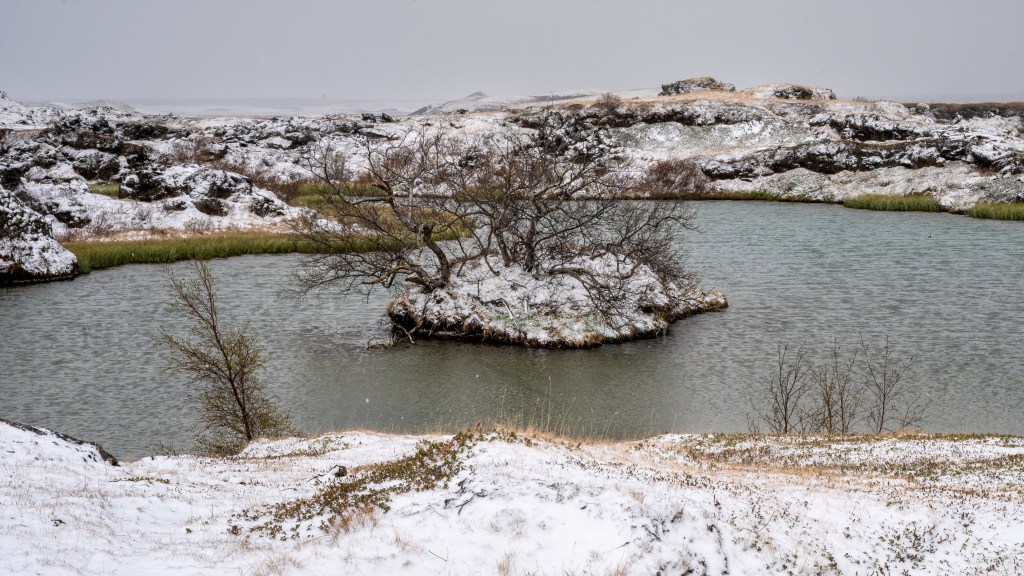
The road bordering the lake gave us beautiful views of the water, lava formations and surrounding landscapes. Even in cloudy weather, the region had a quiet charm. The lake, volcanic terrain and open skies created a completely different atmosphere from anything we had seen so far.
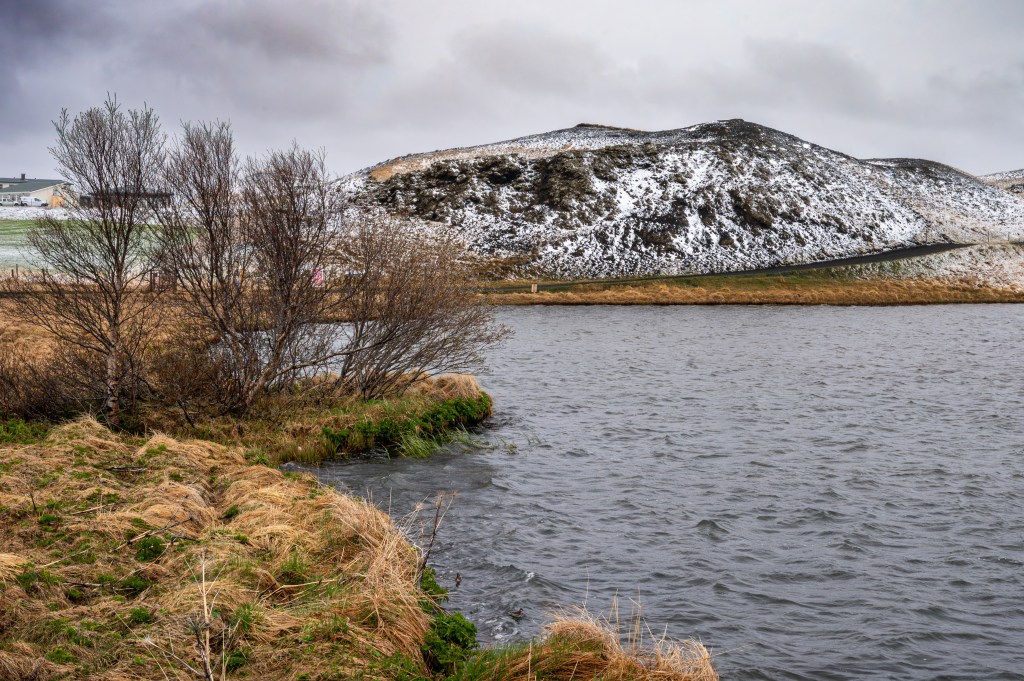
South Iceland had waterfalls and black beaches.
The southeast had glaciers.
The east had fjords and fairytale towns.
And now North Iceland had snow, geothermal fields and volcanic lake landscapes.
Every day felt like a new chapter.
Stay Near Lake Mývatn
Our stay near Lake Mývatn was a great transit stop.
After a cold, wet and dramatic day, reaching the hotel felt comforting. This was not a day where we needed too much evening activity. The weather had made sure we had already experienced enough drama.
Sometimes, the best part of a travel day is simply reaching your hotel, removing wet jackets, warming up and replaying the day in your mind.
And this day gave us plenty to replay.
Day 5 Summary
Route: Seyðisfjörður → Egilsstaðir → Stúdlagil Canyon → Dettifoss → Hverir → Lake Mývatn
Approximate drive time: 4.5 to 5.5 hours, excluding stops and Stúdlagil hike
Hotel stay: Mývatn area
Highlights: Hotel Aldan breakfast, Stúdlagil Canyon east-side trail, snowy roads, Dettifoss, Hverir geothermal area, Lake Mývatn drive
Day 5 was not an easy sunny travel day.
It was snowy, rainy, windy and cold.
But that is exactly what made it special.
Maybe that is the real magic of Iceland — even when the weather tries to make things difficult, the country somehow manages to make the difficulty look spectacular.
Day 6: Mývatn to Siglufjörður
Hverfjall Crater, Goðafoss, Forest Lagoon, Troll Peninsula and Magical Siglufjörður
Day 6 was like opening a secret room in Iceland’s palace — volcanic craters, snowy landscapes, warm lagoons, coastal roads and a fishing town straight out of a storybook.
By Day 6, we had stopped trying to predict Iceland.
Every time we thought we had seen enough beauty for the trip, Iceland opened another door and showed us one more room in its endless palace of landscapes.
This day began in snow and ended in a fairytale fishing town.
Not a bad itinerary, I would say.
Morning at Hverfjall Crater
In the morning, with the landscape still covered in a soft layer of snow, we proceeded towards Hverfjall Crater.
This was one of the most dramatic short climbs of the trip.
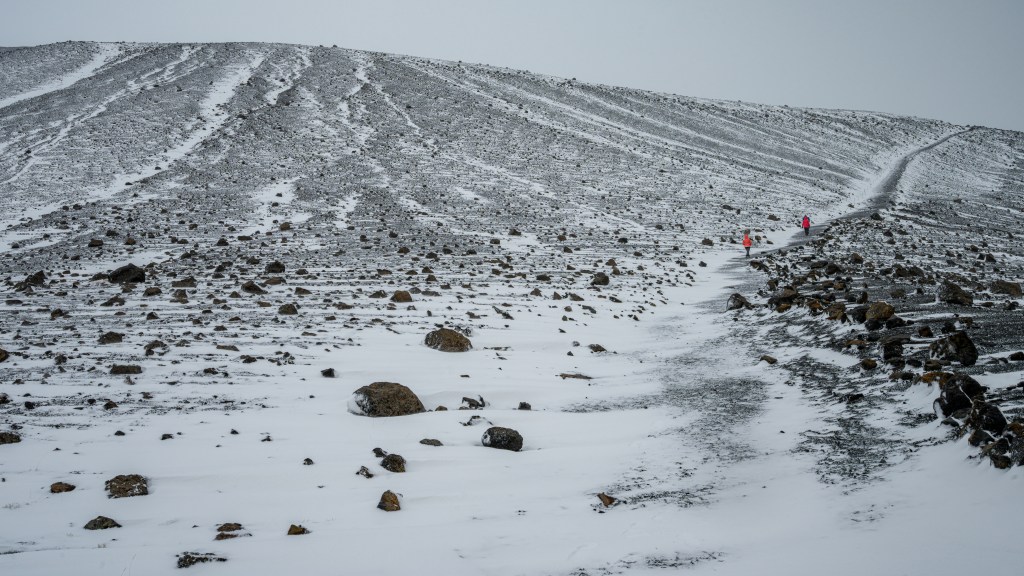
There was powdered snow all around, the sky was moody, and there was not a single soul in sight. The climb to the crater felt raw and cinematic. The black volcanic earth, white snow and empty surroundings created a landscape that looked almost otherworldly.
Hverfjall is a large volcanic crater near Lake Mývatn. Once you reach the rim, you get a wonderful view of the crater itself and the surrounding volcanic landscape.
There is a circumferential trail around the crater rim, and walking it would have been an amazing experience. Unfortunately, our schedule did not allow it. So, with some regret and a little bit of the now-familiar clock-cursing, we moved on.
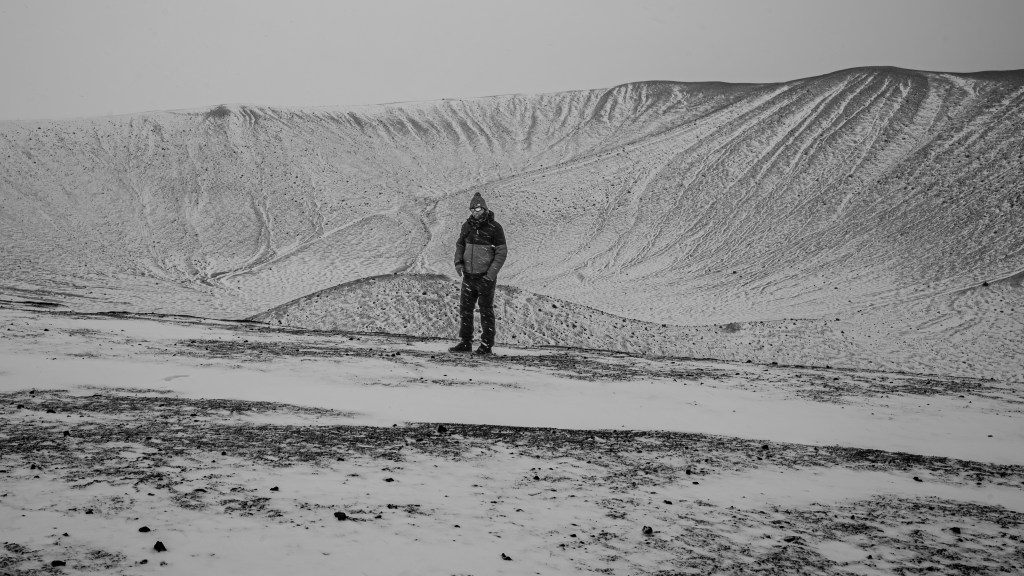
This is one of the truths of the Ring Road: you will never see everything.
You just have to accept that Iceland will always keep something pending for your next visit.
Goðafoss — The Waterfall of the Gods
Our next stop was Goðafoss.
By this point in the trip, we had already seen so many waterfalls that Goðafoss had almost become a “tick mark” stop in our mind.
But as Iceland repeatedly taught us, there is no such thing as “just ticking off” a place here.
Goðafoss made sure we understood why it is called the Waterfall of the Gods.
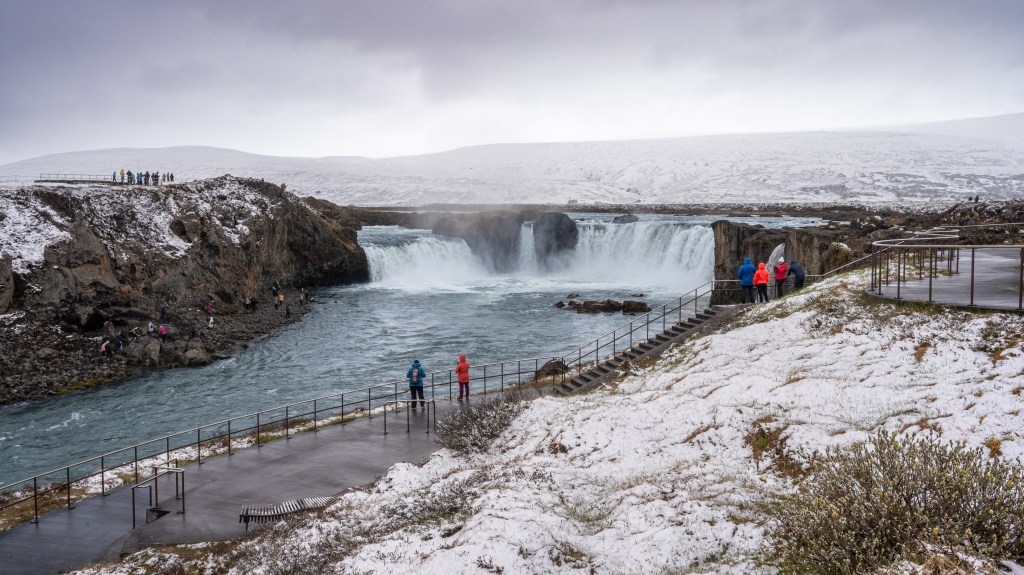
The waterfall is visible from a distance even before you reach the parking area. As you drive closer, it stays in sight, slowly growing larger, building anticipation in a very graceful way.
Unlike some waterfalls that suddenly appear after a walk, Goðafoss announces itself from afar.
The shape of the waterfall is beautiful — wide, elegant and powerful without being intimidating. The water spreads across the horseshoe-shaped edge and falls into the river below, creating a scene that feels balanced and majestic.
There are parking areas on both sides, east and west. Either side gives good views, but if you have time, it is worth seeing the waterfall from both perspectives.
The weather was snowy but comfortable, and that light snow added a special charm to the whole setting.
Goðafoss was not just another waterfall.
It was a reminder that Iceland’s famous sights are famous for a reason.
Akureyri and a Change of Plan
From Goðafoss, we moved towards Akureyri, the unofficial capital of North Iceland.
We avoided the toll tunnel and instead took the scenic road above. This turned out to be a very good decision. The views along the way made the extra drive worthwhile.
Our next planned stop was Forest Lagoon.
Some of us had originally booked whale watching from Akureyri, but due to the weather, the tour was cancelled. Instead, they explored Akureyri town.
And this is something Iceland taught us again and again.
In Iceland, Plan B is never necessarily inferior.
Sometimes it is equally good. Sometimes it is even better.
Forest Lagoon — Warm Water, Snow and Silence
Forest Lagoon turned out to be one of the most memorable experiences of the trip.
Imagine sitting in a warm geothermal lagoon surrounded by forest, with a view of Akureyri, snow-covered mountains in the distance, near-zero temperature around you, and light snow sprinkling from above.
Actually, we did not have to imagine it.
We got to experience it.
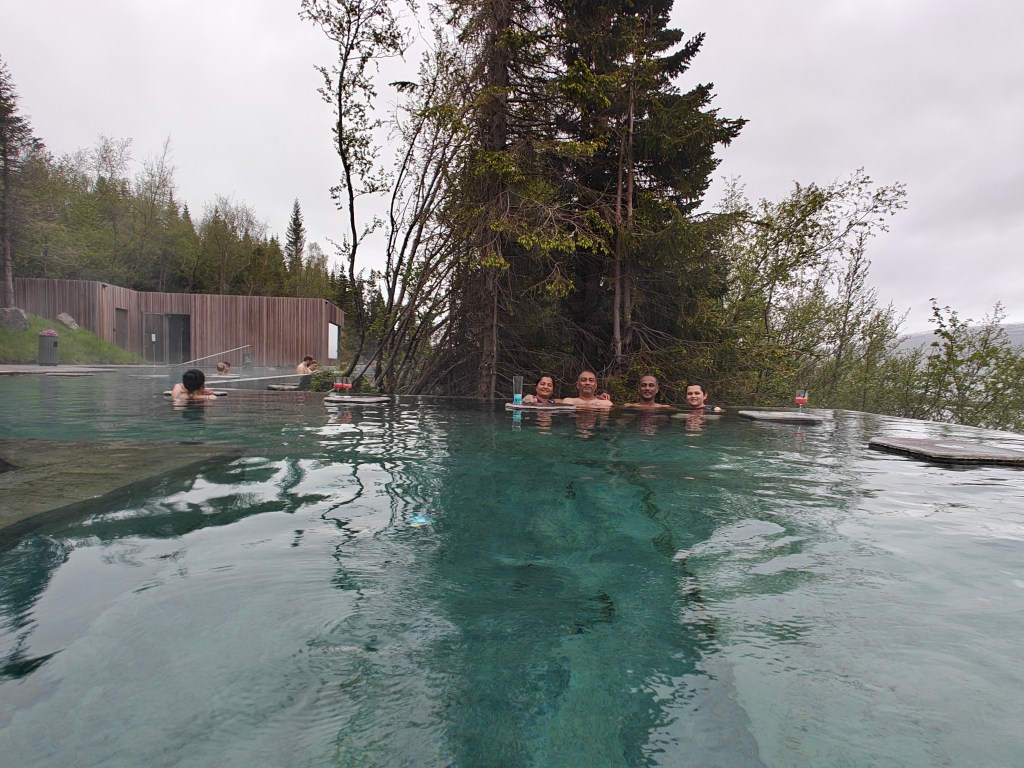
The contrast was magical — warm water around the body, cold air on the face, snow in the surroundings and mountains in the distance. It was peaceful, refreshing and deeply relaxing.
We had already planned to visit the famous Blue Lagoon on the last day, so Forest Lagoon was supposed to be an additional experience.
But in hindsight, Forest Lagoon felt even better than Blue Lagoon.
Maybe because it was quieter.
Maybe because of the snowy setting.
Maybe because it came as a surprise.
Or maybe because after several days of driving, walking, wind and cold, the warm water felt like Iceland rewarding us personally.
Whatever the reason, Forest Lagoon was a highlight.
Driving the Troll Peninsula
After Forest Lagoon, we began one of the most beautiful driving stretches of our entire Iceland trip — the drive towards Siglufjörður through the Troll Peninsula.
Earlier, I had described the drive from Egilsstaðir to Seyðisfjörður as one of the best drives of the trip.
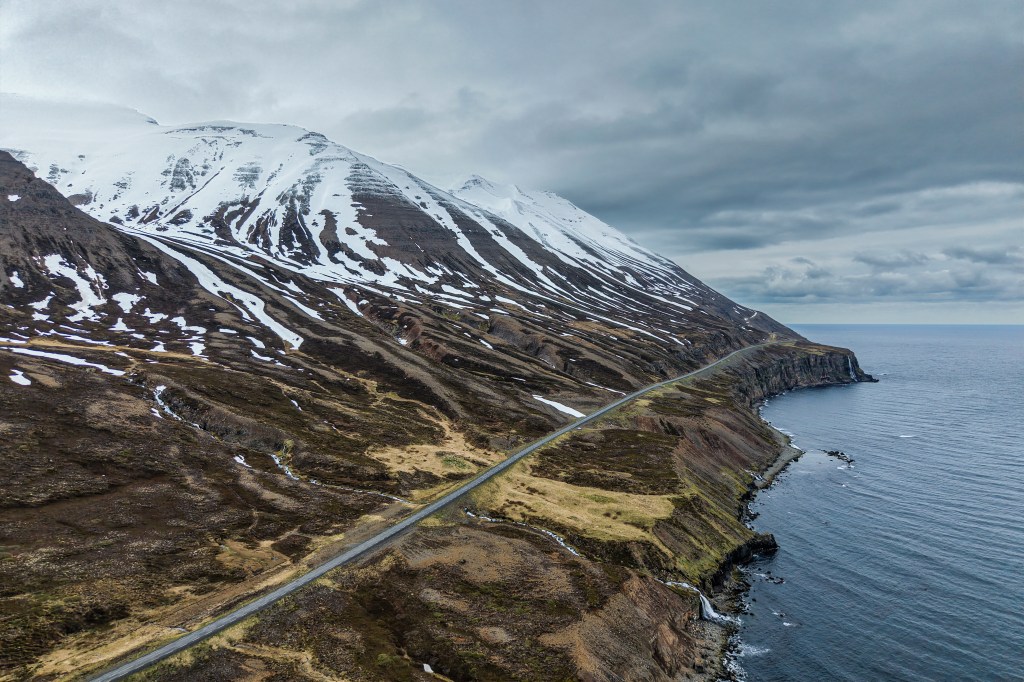
I had been careful not to call it the best.And this was the reason.
The Troll Peninsula drive was equally good, if not better.
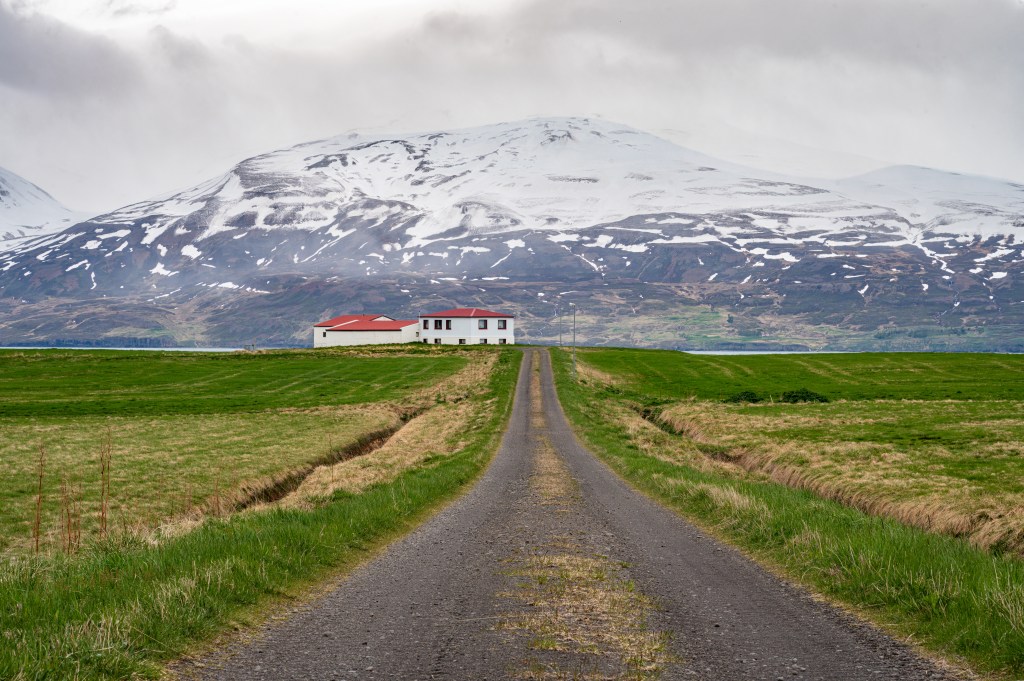
This route was straight out of a fairytale. Snow-clad mountains stood on one side, the vast sea stretched on the other, and the road curved gracefully through the landscape. Add to that a lovely car, good music and the freedom of a self-drive trip — what else does one want from a road journey?
Well, maybe a lovely place to stay at the end.
And Iceland gave us that too.
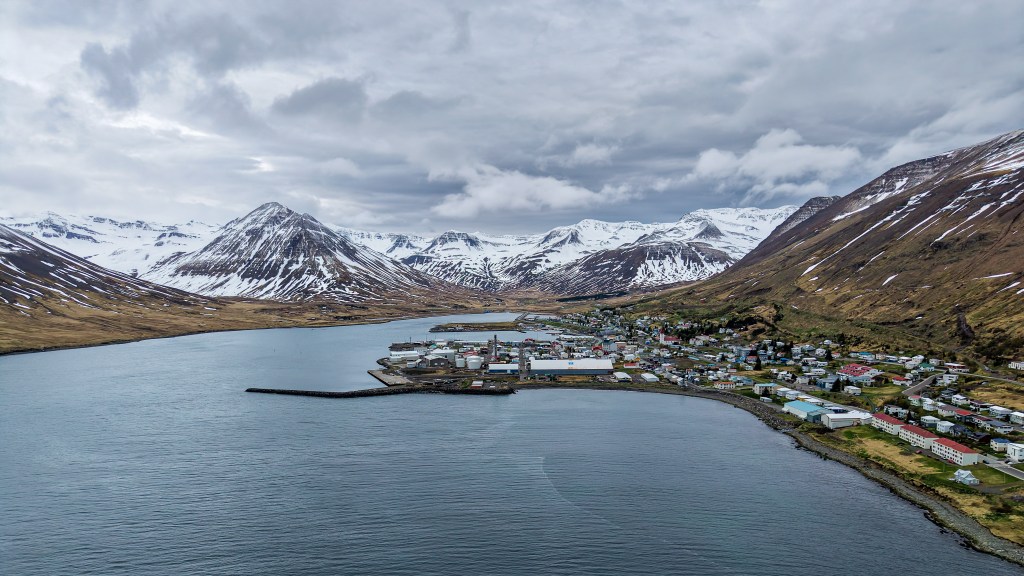
Siglufjörður — Another Fairytale Town
Our halt for the night was Siglufjörður.
Like Seyðisfjörður, this town was slightly off the main Ring Road. And just like Seyðisfjörður, it turned out to be one of our best stays in the whole of Iceland.
These two towns — Seyðisfjörður in the east and Siglufjörður in the north — became our favourite overnight stops.
Siglufjörður is a small fishing town surrounded by mountains and water. It has a quiet, end-of-the-world charm. The setting is dramatic, but the town itself feels peaceful and welcoming.
Our hotel, Sigló Hotel, was in a dreamy, magical location.
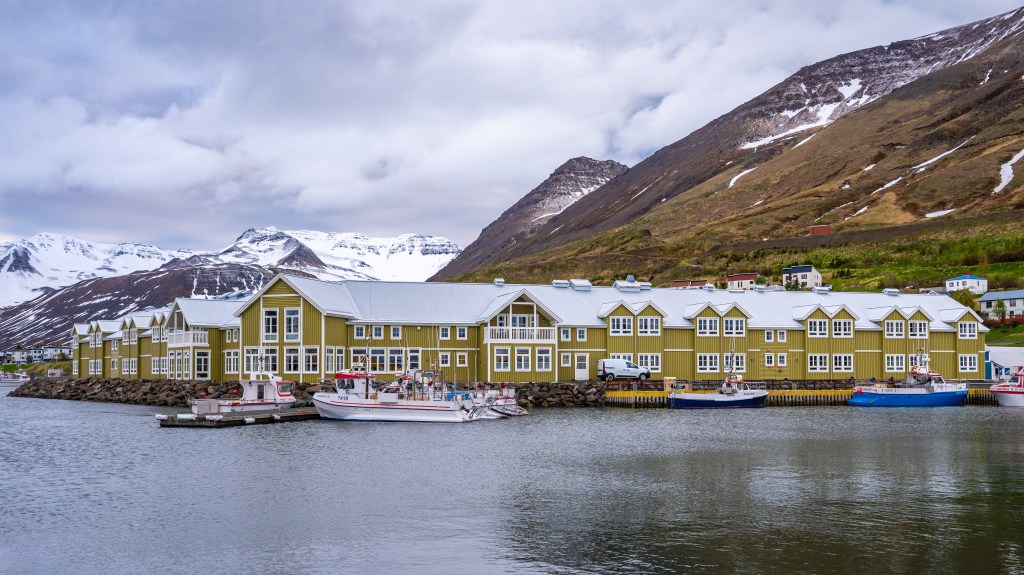
The surroundings were so beautiful that the hotel did not feel like just a place to sleep. It felt like part of the experience.
Evening and Morning Walks
Once again, the simple walks around the town became one of the best parts of our stay.
In the evening, we walked slowly through the area, taking in the calmness, harbour, mountains and soft light. The next morning, we repeated the experience.
These walks were meditation in themselves.
No big attraction.
No entry ticket.
No fixed agenda.
No rush.
Just walking in a quiet Icelandic town, breathing cold clean air, watching the mountains and feeling completely present.
I am sure these morning walks must have increased my lifespan by a few years.
At least they certainly improved the quality of those years.
Day 6 Summary
Route: Lake Mývatn → Hverfjall → Goðafoss → Akureyri → Forest Lagoon → Troll Peninsula → Siglufjörður
Approximate drive time: 3.5 to 4.5 hours, excluding stops
Hotel stay: Sigló Hotel, Siglufjörður
Highlights: Hverfjall Crater, Goðafoss, Forest Lagoon, scenic Troll Peninsula drive, Siglufjörður evening and morning walks
Day 6 was one of the most complete days of our Ring Road.
If Seyðisfjörður had stolen our heart in East Iceland, Siglufjörður quietly came and sat beside it.
By now, Iceland had made one thing very clear.
The famous sights are wonderful.
But sometimes, the places slightly off the main route are the ones that stay with you the longest.
Day 7 and Day 8: Siglufjörður to Reykjavík and the Final Goodbye
Grafarkirkja, Reykjavík, Perlan, Blue Lagoon and the End of the Ring Road
Day 7 and Day 8 felt like listening to a ghazal after a rock concert — softer, slower and still beautiful in their own way.
Every good thing has to end.
And so did our Ring Road journey.
After six days of waterfalls, glaciers, black beaches, fjords, snow-covered mountains, geothermal fields and fairytale towns, our final driving day felt a little anticlimactic.
But perhaps that was expected.
After all, when Iceland has been performing like a full orchestra for a week, even a quieter final movement feels different.
The Long Drive Back Towards Reykjavík
Day 7 was mainly our return drive towards Reykjavík.
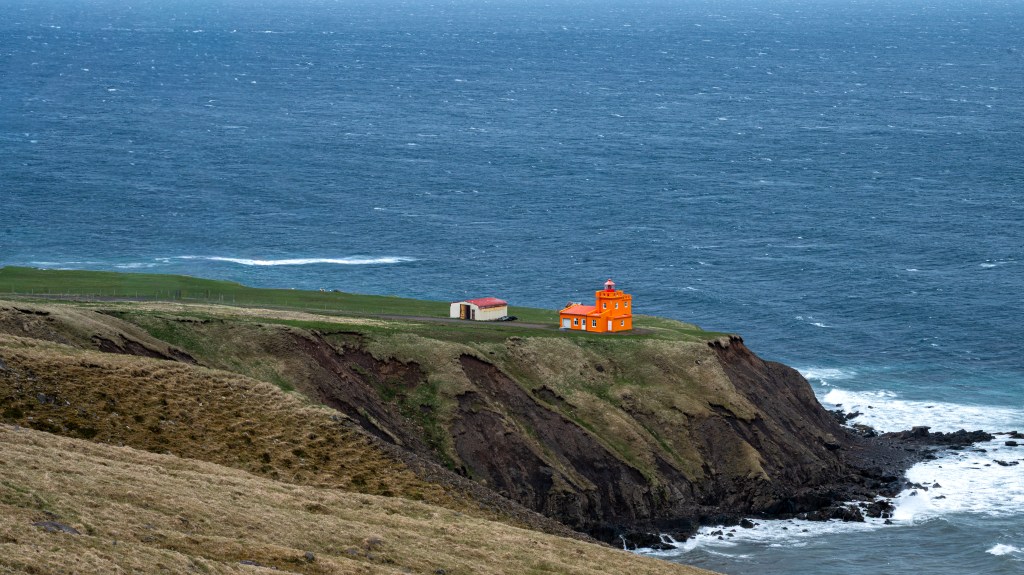
This was the stretch we had deliberately kept for the end of the trip when we planned our counterclockwise route. By now, most of the major dramatic sights were behind us, and the day was more about completing the loop and slowly returning to city life.
On the way, we visited the lovely old turf church, Grafarkirkja.
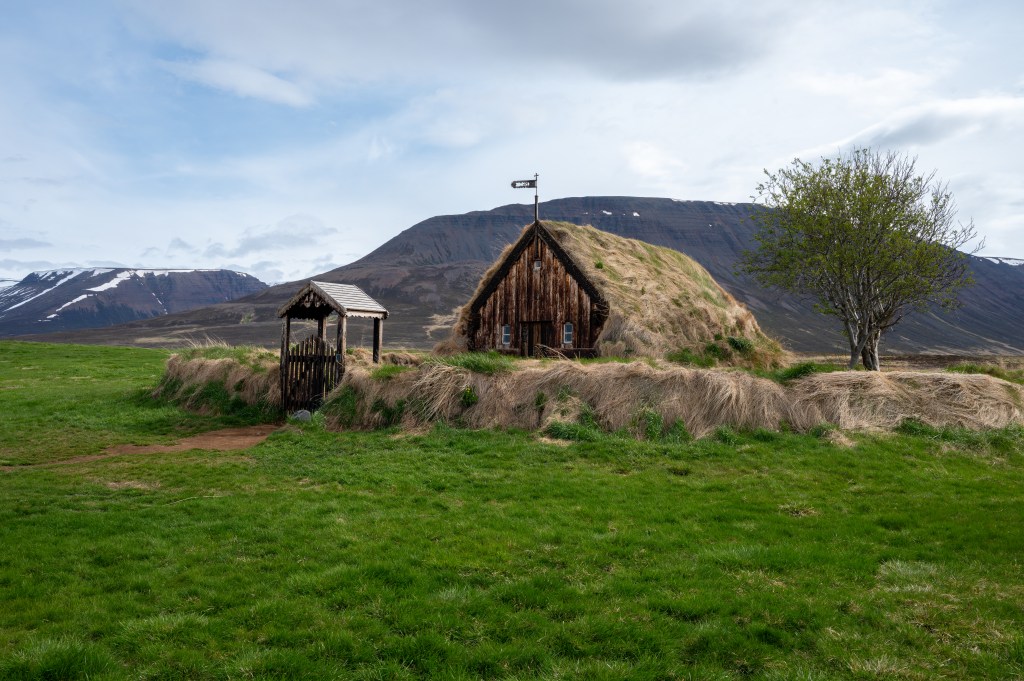
Set beautifully in the landscape, this small historic church has a quiet charm. It does not shout for attention. It simply sits there, surrounded by open countryside, looking like something from an older Icelandic storybook.
After days of massive waterfalls and glaciers, Grafarkirkja felt gentle and peaceful.
We skipped a few other potential stops on the way and reached Reykjavík earlier than expected. Our stay for the night was at Reykjavík Grand Hotel, and after checking in, we decided to explore the city in the evening.
Reykjavík by Electric Scooter
After a week of driving across Iceland, we explored Reykjavík in a completely different way.
We downloaded the Hopp app and used electric scooters to move around the city. It turned out to be a fun and convenient way to explore Reykjavík, especially around the central areas.
After long highway drives and mountain roads, riding an electric scooter through colourful city streets felt almost playful.
Our first major stop was the famous Hallgrímskirkja Church.
Hallgrímskirkja and the Streets Around It
Hallgrímskirkja is one of Reykjavík’s most iconic landmarks. Its tall, striking design is inspired by Iceland’s basalt lava formations, and it dominates the skyline of the city. The church looks modern, simple and grand at the same time.
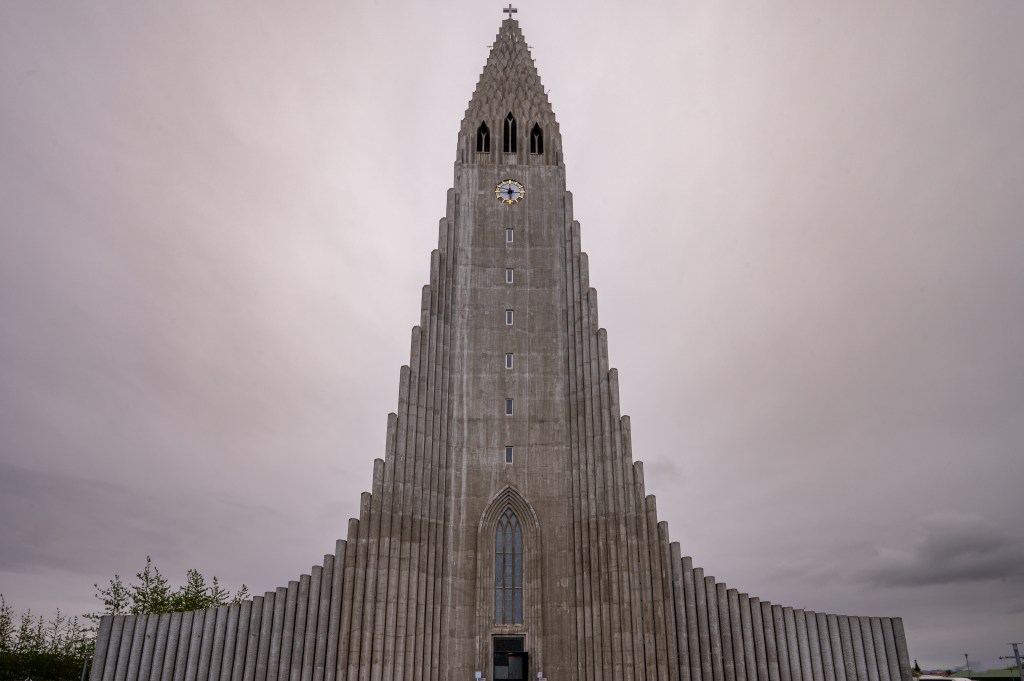
Standing in front of it, you immediately understand why it is one of the most photographed places in Reykjavík.
We explored the surrounding streets at a relaxed pace. The colourful shops, cafes, street art and the famous rainbow street gave the area a cheerful charm.
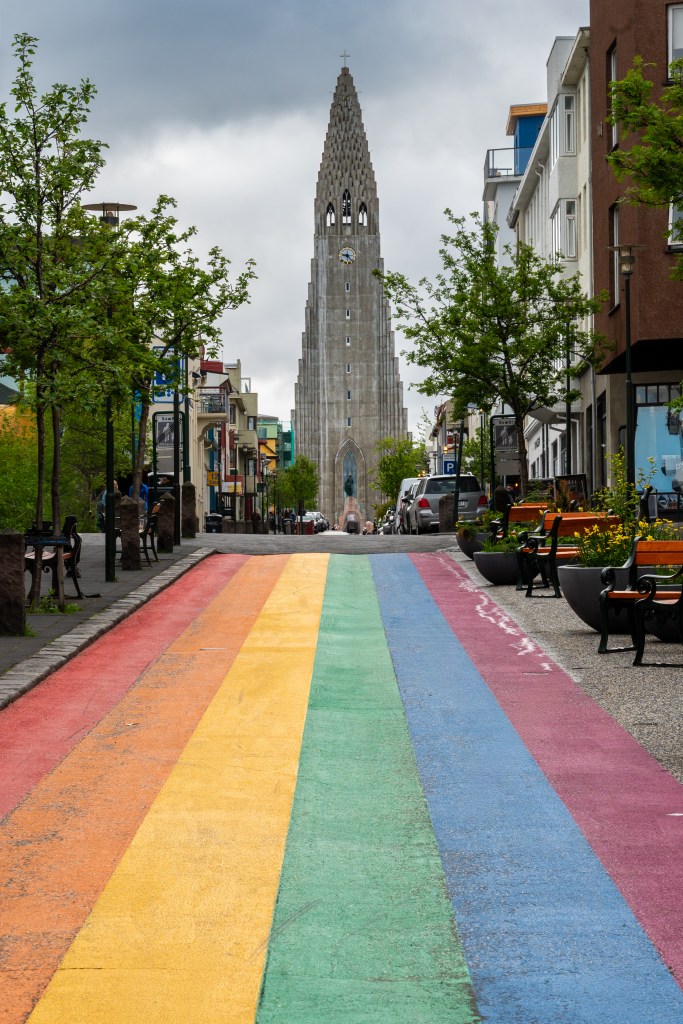
After seven dramatic days in nature, Reykjavík felt like a gentle shift in mood.
The Ring Road had been wild and loud.
Reykjavík was softer, slower and more relaxed.
Seafood Soup and Hot Dogs
Near the church area, we found a small food truck that served one of the best seafood soups I have ever had.
Right next to it was another truck serving the famous Icelandic hot dogs.
After so many days of road food, soups and supermarket meals, this simple food-truck dinner became surprisingly memorable. The seafood soup was warm, rich and perfect for the chilly evening.
In fact, we liked it so much that we went back the next day too.
Sometimes, the most cherished food memories do not come from fancy restaurants. They come from standing near a street-side truck in cold weather, holding a hot bowl of soup and wondering why life cannot always be this simple.
Day 8: Reykjavík and Perlan
The next day, we explored Reykjavík more slowly.
One of our main stops was Perlan.
Perlan is a great place to understand Iceland better, especially after completing the Ring Road. It gives a good recap of Iceland’s natural history, glaciers, volcanoes and landscapes. After actually seeing so much of the country, the exhibits felt more meaningful.
The experience of virtually entering a volcanic crater was particularly interesting. It added another layer to everything we had seen during the trip — the lava fields, geothermal areas and volcanic landscapes suddenly felt even more connected.
The viewing deck at the top of Perlan gave us a wonderful panoramic glimpse of Reykjavík.
From there, the city looked calm, compact and beautifully framed by sea and mountains.
Walking by the Sea
We also spent time walking near the waterfront.
The Harpa Concert Hall, with its striking glass architecture, was a pleasure to see. The building reflects light beautifully and stands as one of Reykjavík’s most modern landmarks.
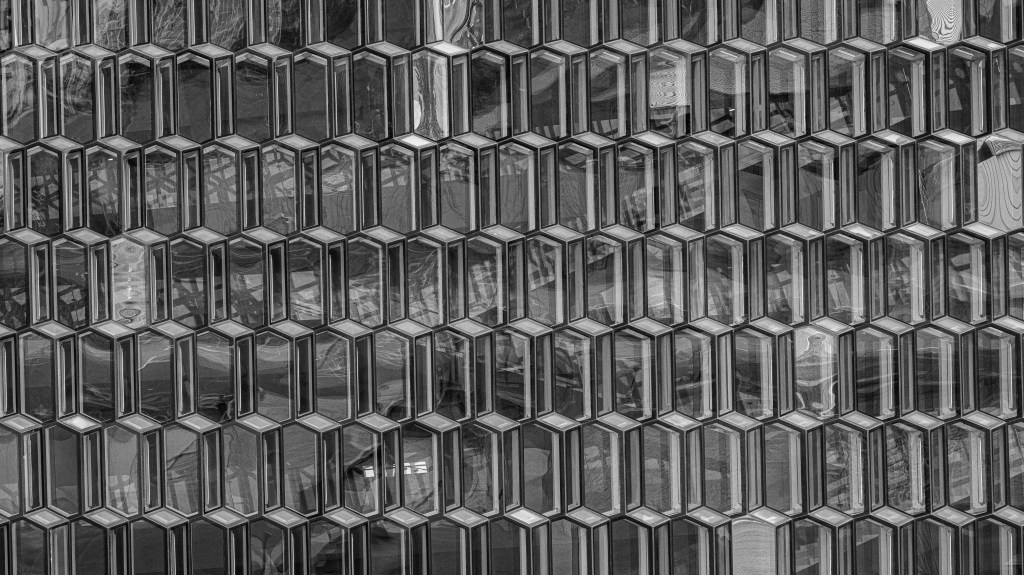
Nearby, the Sun Voyager sculpture added an artistic and peaceful touch to the seaside walk. With the sea, sky and mountains in the background, it made for a lovely stop.
Exploring Reykjavík by scooter and on foot gave us a completely different experience from the rest of the trip.
No dramatic hikes.
No long drives.
No rushing between waterfalls.
Just slow movement through a small, charming city.
And among all these city memories, two things stayed very strongly with us — the cinnamon rolls at Brauð & Co. and that unforgettable seafood soup near Hallgrímskirkja.
Travel memories are strange.
You may forget the exact order of viewpoints, but you rarely forget a good cinnamon roll.
Blue Lagoon — The Final Iceland Experience
In the evening, after checkout, we visited the famous Blue Lagoon.
This was very conveniently located on the way to Keflavík Airport, making it a perfect final stop before departure.
The Blue Lagoon is one of Iceland’s most iconic experiences. The milky blue geothermal water, black lava fields around it, steam rising into the cold air and the whole spa-like setting make it very special.
Yes, it is touristy.
Yes, it is expensive.
But as a final Iceland experience, it works beautifully.
Soaking in the warm blue water on the last evening, we mentally replayed the entire trip — the drives, waterfalls, glaciers, black beaches, snow, fjords, quiet towns, soups, winds, laughter and endless daylight.
It felt like the perfect place to pause and take it all in.
Not just to relax the body.
But to absorb the journey.
Goodbye to Our Travel Companion
After Blue Lagoon, it was time to return our car.
Our lovely Kia Sportage automatic had been our travel companion throughout the Ring Road. It had carried us through rain, snow, wind, fjords, long drives, supermarket stops, camera bags, snacks, jackets and endless conversations.
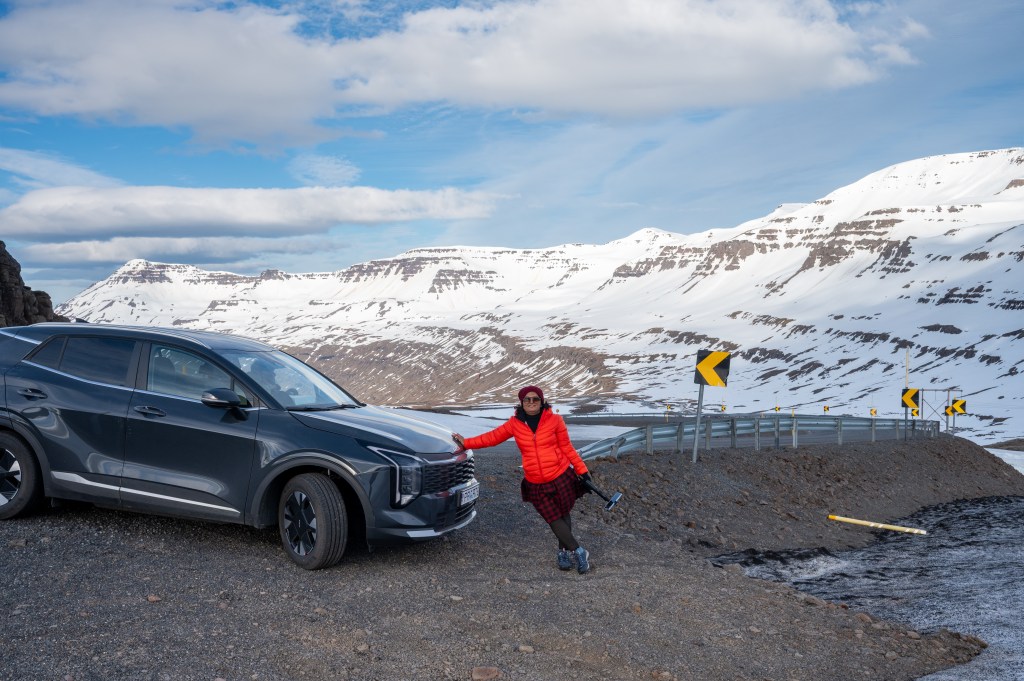
Returning it felt surprisingly emotional.
A good car on a road trip becomes more than a vehicle. It becomes part of the story.
With heavy hearts, we reached Keflavík Airport.
The Ring Road was complete.
Until Next Time, Iceland
As we prepared to leave, one thing was very clear.
This was not goodbye forever.
It was only goodbye for now.
Iceland had given us far more than we had expected — not just famous sights, but moments of silence, wonder, laughter, humility and gratitude.
We had seen waterfalls thundering in mist, glaciers floating in lagoons, black beaches shining with ice, tiny towns hidden between mountains, geothermal steam rising from the earth, snow falling over hot lagoons and roads that looked like they were designed by dreams.
And somewhere during those eight days, Iceland had quietly made a promise with us.
That we would return.
So we bid adieu to Iceland with full hearts, tired legs, full memory cards and a promise to meet again soon.
Day 7 and Day 8 Summary
Day 7 Route: Siglufjörður → Grafarkirkja → Reykjavík
Approximate drive time: 5 to 6 hours, excluding stops
Hotel stay: Reykjavík Grand Hotel
Day 7 Highlights: Grafarkirkja, Reykjavík by Hopp scooter, Hallgrímskirkja, rainbow street, seafood soup, Icelandic hot dogs
Day 8 Route: Reykjavík → Perlan → Waterfront/Harpa/Sun Voyager → Blue Lagoon → Keflavík Airport
Approximate drive time: 1.5 to 2.5 hours within Reykjavík and towards Keflavík, excluding stops
Final day stay: Departure night / Keflavík Airport
Day 8 Highlights: Perlan, Reykjavík viewpoint, Harpa, Sun Voyager, Brauð & Co., Blue Lagoon, car return
The final stretch of the trip was quieter compared to the dramatic previous days, but it gave the journey a beautiful ending.
Day 7 completed the Ring Road and brought us back to Reykjavík. Day 8 allowed us to enjoy the city at a slower pace before ending the trip at Blue Lagoon.
It was not the loudest part of the journey.
But it was the perfect closing note.
Like a ghazal after a rock concert.
Final Thoughts on the Ring Road
Driving Iceland’s Ring Road is not just about covering a route.
It is about watching a country transform every few hours.
In eight days, we saw waterfalls, glaciers, black beaches, floating icebergs, fjords, snow-covered mountains, geothermal fields, volcanic craters, peaceful fishing towns and one of the most beautiful driving routes we have ever experienced.
Was it perfect?
Of course not.
The weather changed constantly. Some places had to be rushed. Some hikes had to be skipped. Some plans changed. The wind behaved like it had personal issues with us.
But that is Iceland.
It is not polished perfection.
It is raw, wild, unpredictable and unforgettable.
And that is exactly why it stays with you.
For Indian travellers planning a self-drive trip, the Ring Road may look slightly intimidating at first. But with good planning, sensible driving, early bookings and realistic expectations, it is very much doable.
More importantly, it is absolutely worth it.
Because some journeys do not just show you places.
They change the way you look at travel itself.
For us, Iceland’s Ring Road was one such journey.
Link for first Part;
https://rkphotoblogs.com/2026/06/17/iceland-on-your-own-wheels/
 A Voyage Clicked
excellent write-up,feel happy that I had experienced the trip with all like minded friends.
LikeLiked by 1 person
thanks
LikeLike